The First Lady, a Robot and Global Calls for Caution
Melania Trump closes the last day of her technology summit for spouses of international leaders with a push for AI in education. Spouses demand safety protocols and laws to protect children worldwide.

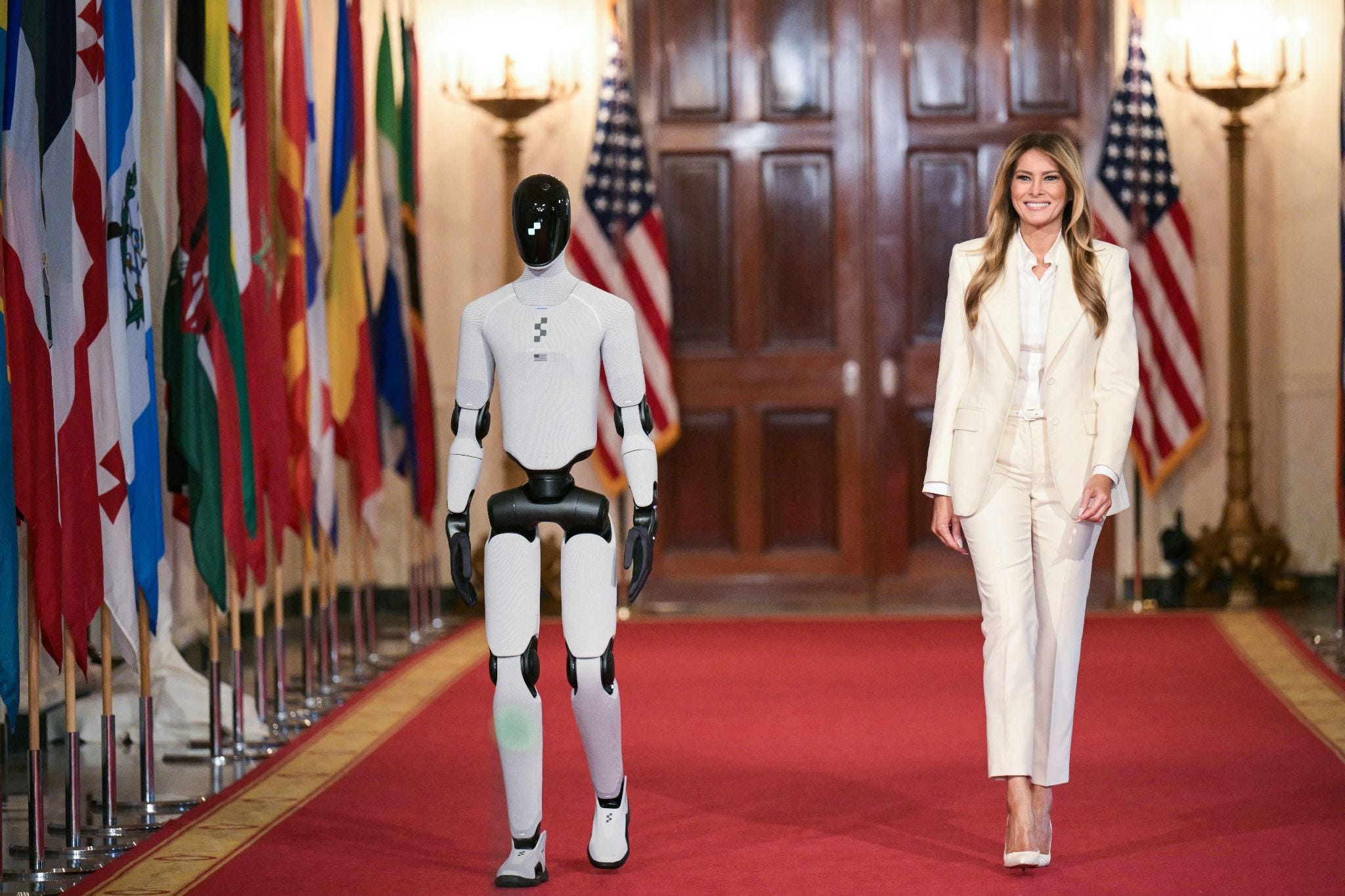
A human look-alike robot walked alongside First Lady Melania Trump on the red-carpeted hall leading to the East Room of the White House Wednesday where 45 spouses of global leaders applauded their entrance. The scene was meant to illustrate the fast-paced advancement of technology and point to where the world is headed in the future.
The robot, an American-made humanoid called “Figure 3” by Sunnyvale, California-based Figure AI, mesmerized people as it welcomed participants in 11 languages to the second day of Mrs. Trump’s Fostering the Future Together Global Coalition Summit. The gathering, which included leaders from technology companies, continued discussions about practical solutions that will empower children around the world with the use of technology and education.
That future included a vision laid out by Mrs. Trump about Artificial Intelligence (AI) that placed America at the pinnacle of countries, she said, with an obligation to ensure its children become the most technologically fluent and educated generation in the world. She spoke about robots providing personalized experiences adaptive to the needs of each student. AI-powered robots would boost analytical skills and problem solving and adapt in real time to a student’s pace, prior knowledge, and even emotional state, she said.
By ensuring technology fluency in the United States, Mrs. Trump said it “will secure long-term economic superiority. This will drive GDP expansion, attract global investment, and put our nation in control of arguably, the most important asset in the future—intellectual property.”
That outlook was in stark contrast to some accounts from the spouses of leaders of smaller countries joining her at the table who voiced concerns about technology including access, equity and keeping human teachers central.
Dr. Fatima Maada Bio, first lady of the West African nation Sierra Leone, expressed her optimism about the gathering and her hope “to shape the future of millions of children whose voices are not in this room, but whose lives will be defined by what we do here today.”
She went on saying, “Somewhere today, a child is struggling and studying by candlelights. Somewhere a girl is walking miles to a classroom that may not have a teacher. Somewhere, a boy is full of promises, but cut off from opportunities simply because of where he was born.”
Those were among the realities and challenges mentioned during the discussion by the spouses of leaders from other countries including France, Morocco, United Arab Emirates, Poland, Panama, Malawi and Kosovo.
The answers weren’t readily clear, but the hurdles were.
The spouses in the room marveled at the humanoid and Artificial Intelligence’s potential for changing the world like the way the internet has and like the ways the Industrial Revolution, electricity and space travel have.
But, how it would unfold prompted questions on wide ranging technology issues and repeated calls for caution out of concern for safety, accessibility and equality.
A former teacher, Brigitte Macron, wife of the president of France, Emmanuel Macron, raised the first question when she asked the participants: “What are we doing about screen limiting?”
Macron insisted screen time on devices needed to be limited and even banned from children under 3 years old at places like daycares and all public spaces. And children under 6 years old, she said, should not be exposed to screens unless they are with adults.
With frankness, she said: “Let’s talk about cell phones with or without the internet—none of that before 13.”

In France, she shared, cell phones will be banned from primary, middle and high schools beginning in September and asserted the best way forward was to return to books. Macron also spoke about regulating social media and the use of algorithms along with France’s Ministry of Education adopting programs with mandatory classes in schools about the use of social media. She also talked about France’s continued development of programs fighting cyberbullying.
Panama’s First Lady Maricel Cohen de Mulino, whose country’s population is about 4 million with six of 10 provinces home to indigenous people speaking their own languages, said her position on technology was clear.
“The digital world must be designed with the safety of children at the very center and that requires collective action of governments, families, schools and the technology sector,” she said. “We are not waiting for the problem to define us.”
In 2025, she added, Panama signed into law protections of children from cyber crimes. Panama also is currently considering a draft bill with mechanisms to prevent exposure from harmful social media content in its National Assembly that came from university students committed to the protections that they themselves didn’t grow up with.
Also talked about was teacher training, bridging the urban and rural divides and access to computers that young people in countries around the world still do not have.
Kosovo’s First Gentleman Lt. Col. Prindon Sadriu echoed the cautious optimism around AI and technology’s future.
“Technology opens extraordinary doors to learning, imagination and human connection that previous generations could not have imagined,” he said. “But it carries real risks, cyber bullying, exploitation and violations of privacy. These are not abstract threats. They are things children encounter every single day and they demand that governments, educators, families and technology companies work together.”

How the countries including the United States act after the summit is to be seen. However, Mrs. Trump encouraged the spouses to take proactive steps including pledging to host regional meetings, collaborating with the private sector, unlocking access to technology for those who require assistance, drafting legislation to protect children and collaborating with a member nation in their region.
“Fostering the Future Together is built on the theory that efficiencies derived from Artificial Intelligence will improve various parts of society, such as commerce, healthcare and food security, ultimately lifting all economies,” she said. “This technology may reset the modern world order and rebalance power. Your children must be prepared to ascend within this framework.”


