White House Ballroom Plan Is Slated for Final Vote
On Thursday, the National Capital Planning Commission is expected to vote on the president’s 90,000-square-foot White House addition; review his plans for a White House visitor screening facility.

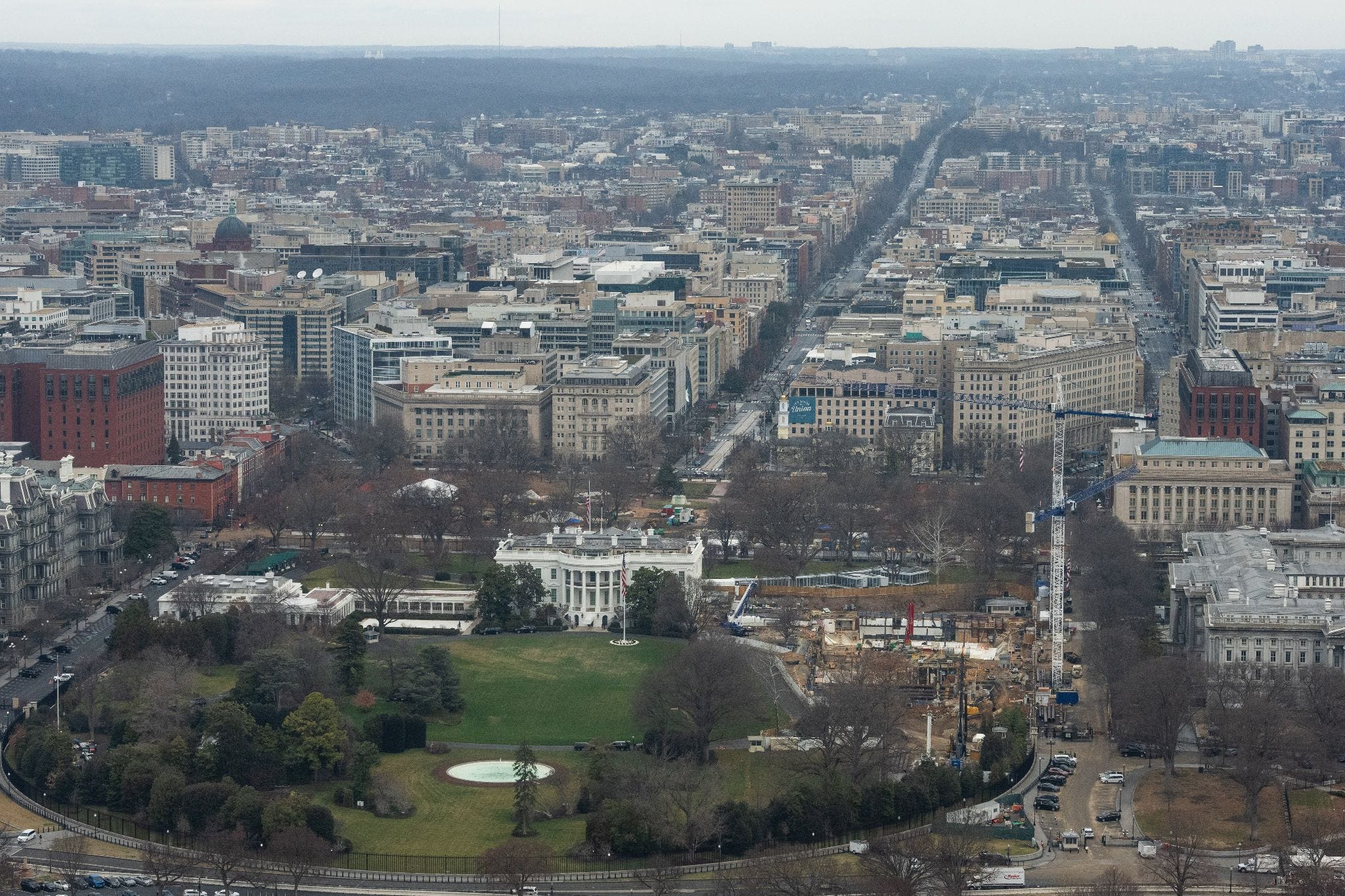
A Washington, D.C., design review panel, the National Capital Planning Commission, is set to cast a final vote Thursday on President Donald Trump’s proposed White House ballroom as part of plans for a new East Wing addition that were submitted in January.
But what could keep the project from moving forward is an anticipated decision from a Washington, D.C., federal district judge that could halt construction of the ballroom. And, it could come in the remaining days before the end of the month.
The National Trust for Historic Preservation filed a lawsuit in December trying to stop the construction of President Trump’s $400 million, 90,000-square-foot ballroom after the East Wing of the White House was demolished in days last October. The National Trust is seeking an injunction by Judge Richard J. Leon, a George W. Bush appointee, and for him to rule that the proposed “East Wing Modernization Project” was out of the president’s scope of authority to construct unilaterally. The nonprofit chartered by Congress argues that Trump’s actions were illegal when he bypassed approvals for demolition and congressional authorization for the project. An injunction would stop the project while the lawsuit moves forward.
Earlier this month during a court hearing, Leon questioned a lawyer for the Trump administration over what the judge called its shifting rationale for the president’s authority, according to Reuters. The judge, noting that the White House grounds are a “special place” and an “iconic symbol” of the nation, reportedly described the administration’s argument that the ballroom was an allowable alteration to the White House as a “brazen” interpretation.
But the most consistent feedback on the president’s proposal has come from the American public, which has voiced overwhelming objections to the ballroom for its size and design. During the public comment portion of a National Capital Planning Commission earlier this month, more than 35,000 written comments were submitted and 104 people had signed up to speak. The reactions from architects, preservationists, professors, historians, former White House staff and ordinary citizens were predominantly negative and the people urged the commission, mostly filled with members appointed by Mr. Trump, to reject the plan.

On Friday, President Trump interjected a brief comment about the proposed ballroom when speaking about the proposed farm bill.
“I love construction,” Trump said. “I love building beautiful things.”
Many experts and professionals in the architecture and design industry have raised concerns that the proposed $400 million, 90,000-square-foot East Wing addition that includes a 22,000-square-foot ballroom is too big, too tall, too costly and too disruptive to the symmetry of the White House complex.
After the public comment portion of the meeting ended, commissioners unanimously tabled discussion of the project to April 2, when a vote on the proposal is expected.
Among the specific design concerns by experts were that the size and mass of the proposed ballroom diminishes the residence and cuts away at the intention of the initial design of the White House—that the president’s house should be the commanding, yet humble, presence of the complex and the West and East Wings should be subordinate and smaller.

Also at issue was how the size of the proposed East Wing introduces an imbalance between the structures with the ballroom dominating. Additionally, experts argued how the axis view on Pennsylvania Avenue from the White House to the Capitol—a foundational, intentional design by George Washington’s 1791 federal city commissioned designer Pierre Charles L’Enfant—would be forever obstructed by the ballroom. And, they raised issues with symmetry, a tenant of the White House’s classical design, as a result of the ballroom’s imbalance and how the structure would protrude into the South Lawn driveway creating a kink in its overall circular symmetry.

Other criticisms leveled included the design of the south portico of the proposed ballroom, which was modified from earlier versions by removing the pediment. Commenters took issue with the Corinthian columns on the portico because they appeared grander than the columns on the residence and blocked views out of the ballroom. The exterior stairs from the ballroom spilling out onto the lawn were also scrutinized for adding to the mass of the addition and providing no access to the ballroom.

When asked if the south portico of the ballroom was essential to the design, the White House-hired architect Shalom Baranes told the commission it was not.
“It’s really an aesthetic decision,” Baranes said.
The National Trust for Historic Preservation suggests with renderings of their own that many of the ballroom’s design issues, including the symmetry concerns, could be addressed if it was simply smaller. Commissioner Phil Mendelson, who has voiced concern over the size and scale of the project, questioned the need for 22,000 square feet for the ballroom when a standard industry size is 15,000 square feet.
Baranes said the extra space was needed to accommodate cameras for journalists, honor guard and additional security space to allow for emergency evacuations.
This week, the commission is expected to take a combined vote on the concept and final design of the proposed project, which also includes a two-story East Colonnade and an outdoor garden. The NCPC has closed the public comment portion for the proposed project. In February, another review panel for federal projects, the Commission of Fine Arts, approved the president’s plan, bypassing the normal procedures of considering preliminary plans first when it instead voted for its preliminary and final approval.
The NCPC on Thursday is also expected to discuss President Trump’s concept plans for a 33,000-square-foot White House visitor screening facility that would replace trailers that have been used in the past by Secret Service before visitors enter the White House. Plans show the entrance would be located at Sherman Park, next to the White House grounds, and that much of the structure would be built underground.
The Commission of Fine Arts reviewed the concept for the new White House visitor screening facility at its March 19 meeting supporting the project’s goals, but requested the president reconsider the design approach for the ground level.
The NCPC meeting is slated for Thursday at 1 p.m. EST and will be livestreamed.
Calendar
March 31, 2026
250th Anniversary of Abigail Adams “Remember the Ladies” Letter
The Adams Presidential Center presents the program “250th Anniversary of Abigail Adams ‘Remember the Ladies’ Letter” with panelists, Liz Covart, Ph.D and Diana Carlin exploring Abigail Adams and the enduring legacy of her remarkable letter from 1776. This in-person and virtual discussion taking place from 5:30 to 7 p.m. EST will examine the powerful call to “Remember the Ladies,” the letter’s lasting impact on American women’s rights, and its meaningful role in shaping the founding ideals of our nation. Panelists will illuminate how Abigail’s voice continues to resonate today. Read more
April 4, 2026
LBJ Library Easter Egg Roll
Future Forum members, bring your families and join the families of Partnerships for Children at the 11th Annual Easter Egg Roll on the lawn of the LBJ Presidential Library, to include Easter Egg Roll and Hunt, ice cream, petting zoo, Easter Bunny and face painting. Read more
April 4, 2026
Remember the Ladies Family Day
George Washington’s Mount Vernon presents “Remember the Ladies Family Day” on April 4, 2026, from 9 to 4 p.m. Discover the nation’s founding mothers during America’s semiquincentennial and explore the many ways in which women supported the cause of liberty and the Revolutionary War.
Participate in hands-on activities, listen to character interpretations, and see demonstrations that highlight the lives and leadership of women at the home of America’s first First Lady, Martha Washington. Read more
April 10, 2026
Legacy Lecture: On the Road with America’s First Ladies
The National First Ladies Library & Museum presents a virtual program of powerful stories about America’s first ladies with Andrew Och, aka The First Ladies Man. The author of the two-volume series Unusual for Their Time: On the Road With America’s First Ladies highlights the women who shaped the presidency and influenced the course of American history. Read more
April 16, 2026
Third Thursday: Journeys That Changed America
The National First Ladies Library & Museum presents on April 16, 2026 from 6 to 8 p.m. local time stories of the first ladies whose travels helped transform diplomacy, leadership, and American life. This in-person Third Thursday program highlights unforgettable journeys: from Jackie Kennedy’s iconic moments abroad to Lady Bird Johnson’s road trips that helped redefine America’s landscapes. Read more
April 22, 2026
Ulysses Grant Deitz to Speak on ‘Julia and Ulysses at Home: The Grants in the White House, 1869-1877’
Julia and Ulysseus Grant would live in the White House for longer than they ever lived in any other house. For Julia, it was home in a way the White House had never been for any previous first family. The Ulysses S. Grant National Historic Site on April 22, 2026 presents an in-person program featuring Ulysses Grant Dietz, great-great grandson of Ulysses and Julia, who will explore Julia’s role as first lady and her substantial impact on the White House itself as well as the places and houses where they lived with their family. Call 314-842-1867 ext. 230 for reservations.
April 23, 2026
From Poise to Purpose: Pat Nixon, Betty Ford, and the Changing Role of First Lady
The Gerald R. Ford Presidential Foundation presents a birthday event at the Ford Presidential Museum in Grand Rapids, Michigan, on April 23, 2026 to honor First Lady Betty Ford, who would be 108 on April 8.
Betty Ford and Pat Nixon shared more than just the first lady position: they also shared a long history of friendship and mutual admiration. Heath Hardage Lee, author of The Mysterious Mrs. Nixon, will discuss Pat Nixon’s life and times as well as the intertwined fates of Mrs. Nixon and Mrs. Ford, and their contrasting styles as first lady. Read more


