

When People Work Toward a Common Goal, ‘Amazing Things Can Be Accomplished’
A White House Christmas decorator reflects on a season of service.

Editor’s note: It is First Lady Jacqueline Kennedy in 1961 who is credited with establishing the selection of a theme for the Official White House Christmas tree. That year, Mrs. Kennedy chose a “Nutcracker Suite” theme that showcased handmade ornaments depicting toys, birds and angels from Pyotr Tchaikovsky’s “Nutcracker” ballet, according to the White House Historical Association. And noted about the ornaments was how they were crafted by disabled volunteers and senior citizens throughout the country.
The tradition of enlisting the talents and dedication of volunteers, since then, has evolved into a highly competitive selection process. Some 12,000 people apply for the 100 or so slots available over the Thanksgiving holiday week when volunteers from across the United States and its territories descend on the White House to transform it for the holiday season in a matter of days.
East Wing Magazine spoke with a few of the 2025 volunteers who helped decorate the White House for the first Christmas season First Lady Melania Trump has hosted since returning to the White House for her husband’s second term—a season that also included fewer decorations for a scaled back tour as a result of the demolition of White House East Wing to make way for President Trump’s planned White House Ballroom. Here is the last of a series of one-on-one volunteer profiles.
The scale of the White House Christmas decorations is so big that the numbers alone can’t tell the story.
Even though this year the footprint of the decorations was significantly reduced resulting from the demolition of the White House East Wing to make way for President Donald Trump’s more than $300 million ballroom, the vast amount of ornaments, ribbon and lights is mind boggling, especially for those tasked with trimming it.
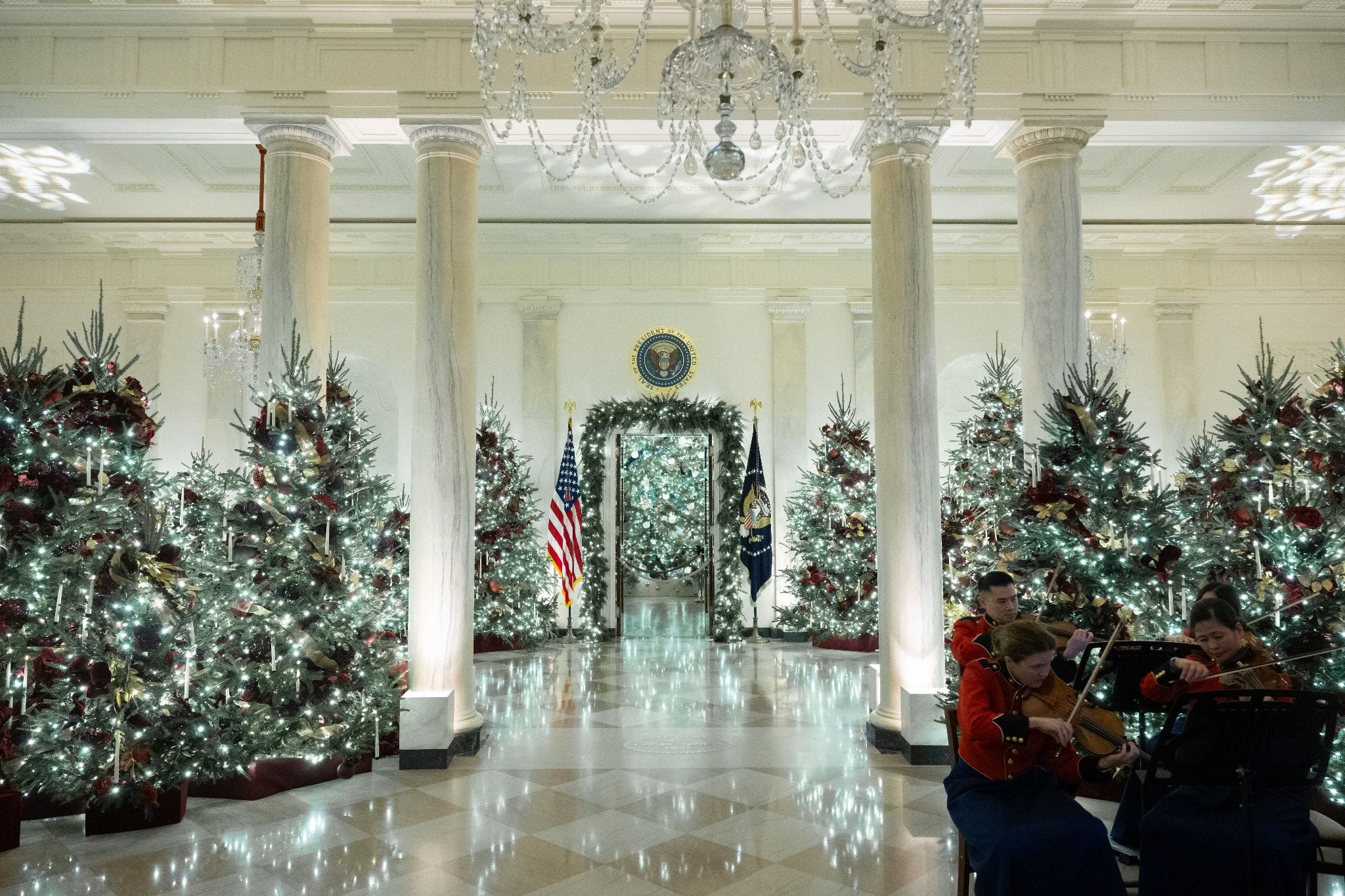
Those numbers went something like this: 75 wreaths with classic red bows hanging on White House windows, more than 50 Christmas trees, 700 feet of garland, 25,000 feet of ribbon and 10,000 butterflies.
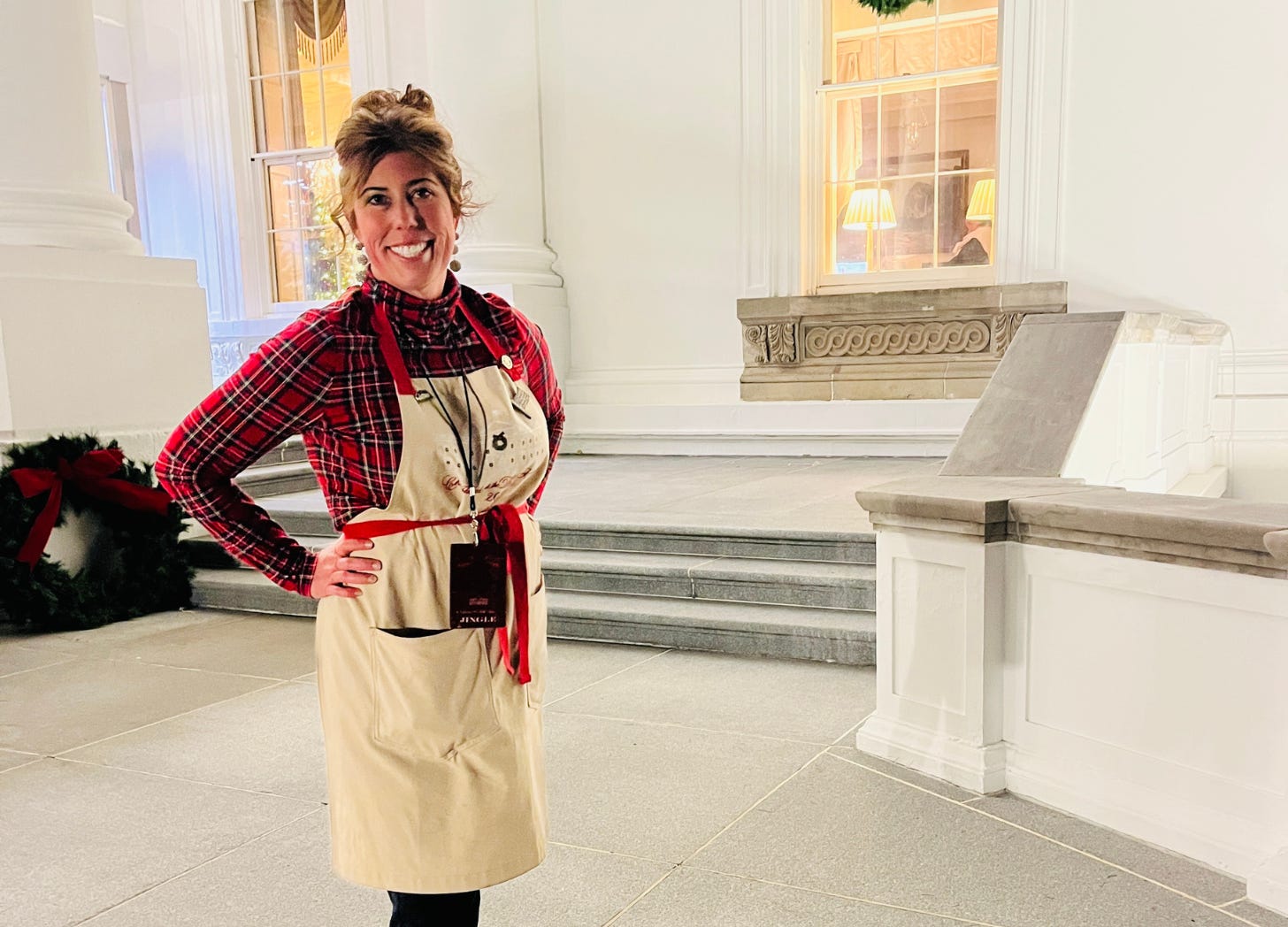
For Christy Schaper, an Alton, Illinois, wife and mother of two college-age sons, words like “immense” also didn’t quite capture the amount of work that, in late November, laid ahead of her and dozens of other volunteers from across the country who were selected to help decorate the White House this year.
But upon reflection, she tells East Wing Magazine that she remembers the artificial flowers—hundreds and hundreds of hydrangeas packed together in opened big, long boxes.
“There were points of time that I looked out over the flowers that were going in the Grand Foyer trees and it looked like a field of hydrangeas,” she says of the scene etched in her mind.
Behind the hydrangeas there were boxes of dahlias. And behind the dahlias, there were boxes of roses. All of the blooms at the start of a six-day stretch of time set aside to decorate the White House needed to be destemmed and arranged for the Christmas trees and garlands they would adorn.
“There were a couple of people on the team working on the other side of those flowers. That was a moment that stood out,” she says. “Boy, I wished I had a snapshot of this.”
In service
Schaper has been volunteering most of her life. It was part of growing up. As a sixth-grader she remembers volunteering at a nursing home and later planning blood drives and dances at school. As a teen, she participated in student council at the high school level. So in raising and eventually homeschooling her sons, she instilled in them that same volunteer spirit, watching them both amass about 800 volunteer hours before heading off to college.
When she applied and was selected for First Lady Melania Trump’s volunteer team to help decorate the White House, the self-described “student of history” thought of a former president’s famous words about service.
“It goes back to JFK,” Schaper says of a line John F. Kennedy spoke in his 1961 inauguration speech, “Ask not what your country can do for you—ask what you can do for your country.”
She joined other selected volunteers—business owners, designers and florists among them—and knew this was her opportunity to contribute and serve with her own set of skills in logistics and fine detailed planning. There was a shared sense, she says, of duty, of honor and of “serving the office of the president.”
Or, as her husband put it, this would be “the Super Bowl of volunteering.”

A meticulous process
Decorating the White House begins the week of Thanksgiving. Volunteer decorators can sign up to work at the beginning of the week, the end of the week or the entire week. Schaper worked the entire week with Thanksgiving off. It began at an offsite location where hours were spent sorting and prepping the decor. “It’s not glamorous work,” she says, adding that a massive amount of organizing takes place before the decorating begins.
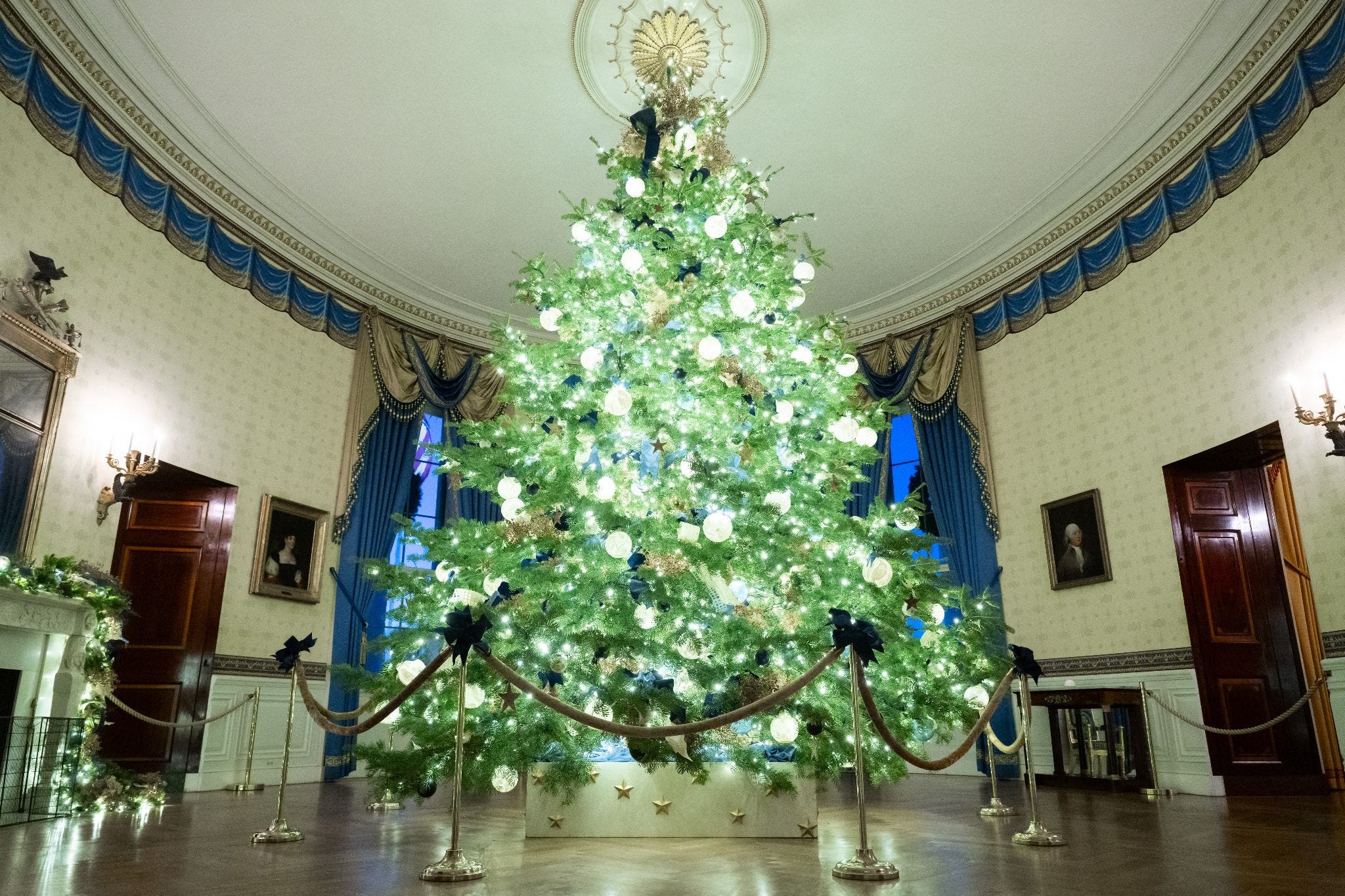
The lighting is particularly labor intensive. By midweek, the primary goal is to get the Christmas trees lit, a meticulous process that involves wrapping each branch of each tree with strands of lights. On one 14-foot tree in the Grand Foyer, for instance, there were 65 sets of lights, Schaper says.
She helped with other details, too, such as dovetailing bows, installing batteries in hundreds of candles that illuminate various Christmas trees and wrapping those candles in velvet ribbon.
“Some of the ornaments were not exactly the correct color, so we adjusted that with paint techniques,” she says.
It’s worth noting that not every decoration that goes into the holiday displays is necessarily new. Many items are reused or modified and made to look new. For instance, ribbon used in the past has been repurposed into garlands.
Those seven days decorating the White House were packed and typically began with breakfast and, later, lunch served to the volunteers in the State Dining Room. With so much needing to be done in such a short amount of time, it was necessary to stay focused on the task at hand. But, there were times when the history of the White House, whether in the form of rooms or artifacts, overwhelmed Schaper.
She explains: The State Dining Room was once Thomas Jefferson’s office. She saw, in person, the Gilbert Stuart Lansdowne portrait of George Washington hanging in the East Room. And knowing, she adds, that former First Lady Dolley Madison was credited with saving that portrait before the British burned down the White House in 1812. And then there was a particularly notable moment for Schaper when she and another volunteer were carrying boxes to the West Wing. She walked along President Trump’s newly installed, controversial “Presidential Walk of Fame” in the White House Rose Garden colonnade that features the portraits of all the presidents. It triggered, she says, memories of her singing an educational song about American presidents with her children, nearly moving her to tears before she moved on to the next task.
“Those were the things that I was thinking about when I was in there—just all the history and all the remarkable first ladies who have been there … and the presidents in their glory and flaws [that have] shaped our nation,” she says.
It was the volunteering, not the politics, though, that carried each of the six decorating days. There’s a respect for the office, respect for one another and respect for everyone’s ability to be free-thinking people, says Schaper, adding, “that’s why we live in this country.”
And at the end of it, she encourages others to serve and volunteer because, she says, when people work toward a common goal amazing things can be accomplished.
Updated: 12/23/25