The Wisdom of Jimmy, the Presence of Rosalynn
How the famed Sunday gatherings in Plains, Georgia, became a testament to an inseparable marriage–time and again.

One Sunday, September 20, 1998, to be exact, Jimmy Carter had nothing but time on his mind.
When the former president, who was a young 73 years old then, looked out at the congregants attending what had become his legendary Sunday School lessons at the Maranatha Baptist Church in his hometown of Plains, Georgia, he quizzed them.
“What visitors can tell me what the Wisdom Books are?” he asked. It wasn’t a rhetorical question. In fact, most of the questions the 39th president of the United States asked were meant to be answered by people in his audience.
That was apparently understood as the visitors shouted out their answers to which he responded: “Very wise. Very good. I told you this was a high quality group.”
This particular lesson began with Ecclesiastes’ book of wisdom and contemplated the concept of time. As he read through a series of verses emphasizing time, Mr. Carter brought the lesson home—close to home—when he spoke candidly to the folks about how his personal fixation with time had been a point of contention between him and his wife, Rosalynn, the former first lady, for years.
“As Rosalynn would testify enthusiastically, I’m obsessed with time and being on time and keeping time,” he said during the lesson.
Present that day in the church, Mrs. Carter did not contest.

A steady presence
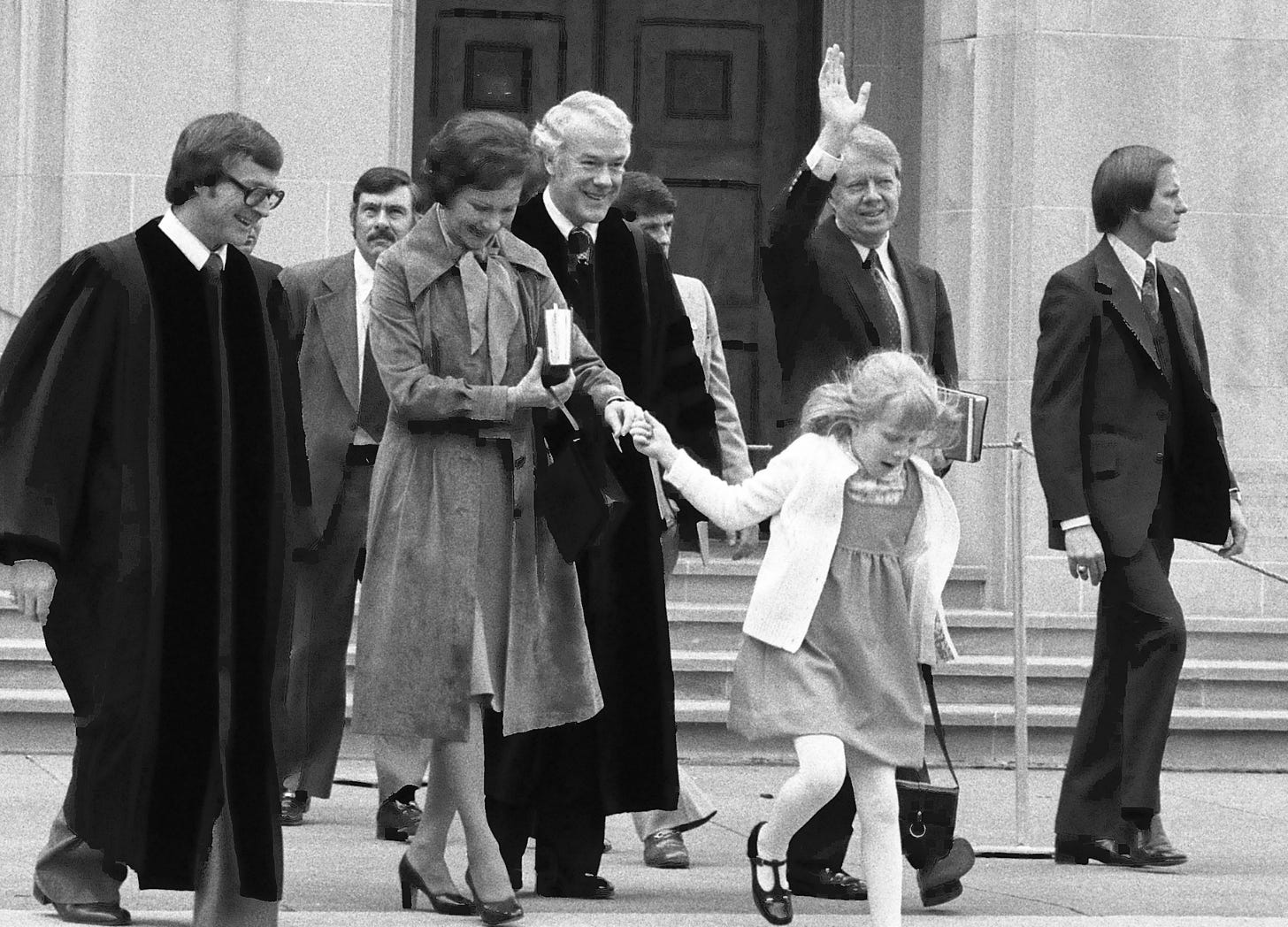
Rosalynn Carter was always present alongside her husband when it came to their shared Christian faith including on most Sundays in their post-White House years at Maranatha Baptist Church. The recently released book, More than a President: Sundays with Jimmy Carter, edited by Andrew Greer, chronicles selected transcribed lessons delivered by Carter from the 1970s when he taught Sunday School lessons as president from First Baptist Church of the City of Washington through his last year in 2019 at Maranatha Baptist.
The collection takes readers not only back in time, but it puts readers “in the room” to hear the back-and-forth discussions between Mr. Carter and the widely diverse audience who came to listen. And very subtly, readers hear Mrs. Carter, also in the room.
“They seem, to me, to be full partners in every aspect of their lives and their work,” Greer, who has been promoting his book for the past several months, tells East Wing Magazine in a recent Zoom interview.

This idea of Rosalynn Carter’s constant presence when it comes to her husband’s career path is mostly settled history, especially for those who were close to the Carters. It is well-documented that in their early years together Rosalynn Carter helped run the family’s peanut farm after he resigned from the Navy. She is wholeheartedly described as a “full partner” when her husband served as governor of Georgia and most notably when he served a single term as president of the United States from 1977 to 1981. Their work continued to intertwine and grow in their post-White House years as global humanitarians for their various causes through The Carter Center in Atlanta.
That partnership, naturally, was exemplified and tethered in their faith.

Kim Carter Fuller, a niece of the Carters and former executive director of Friends of Jimmy Carter National Historical Park, joined in the conference call from inside Maranatha Baptist where she attests to her aunt’s presence and influence in the couple’s church life. Mrs. Carter, in fact, was “famous for correcting him in Sunday School,” Fuller notes.
“I would not doubt that when he worked on those lessons that she didn’t preview the lessons,” Fuller says. “He was constantly running ideas by her. This is common knowledge.”
Fuller, for years, was also a Sunday School fixture at Maranatha where she would teach and also fill in for her uncle. She was close to both her aunt, who died at age 96 in November 2023, and uncle, who died about a year later at age 100 in December 2024. She recalls how the couple prayed together and for others every single night.
Growing up, Rosalynn Carter notes in her autobiography First Lady from Plains that God “was a real presence in my life.” Greer, reading a passage from her book, shares her words:
“We were taught to love him and felt very much the necessity and desire to live the kind of life he would have us live—to love one another and be kind, too, and help those who needed to be helped and to be good. But we were also taught to fear God, and though I loved him, I was afraid of displeasing him all my young life.”
For Greer, her words illustrate just how much faith was part of both of their lives and how, over time, their beliefs grew into seeing the neighbor in need as an equal throughout their lives.
Make no mistake, though, Jimmy Carter was the main draw at his Sunday School lessons.

People like Rev. Barbara Brown Taylor, an author and member of the Board of Trustees at Mercer University by Mr. Carter’s nudging, knew this. By the time Greer’s book published in 2025 she had grown to regret that she never got around to making the 228-mile “pilgrimage” from her home in Clarksville to Maranatha Baptist to study the Bible with the former president, she writes in the Foreword.
“His Sunday school class was so famous that I knew I could watch recordings online or listen to them on Audible, but that wasn’t the point,” she writes. “I wanted to be in his presence.”
Most of the time, though, if visitors were in Mr. Carter’s presence at Maranatha they were likely in Rosalynn’s presence, too.
All in good time
At length on that Sunday in 1998, the former president explained his rigidity about time, specifically punctuality.
At one point, Mr. Carter begins talking about his watch and how it is “rarely five seconds off.” He admits that was the way he lived. He attributed his structure to the Navy or, perhaps, his father, who was even more stringent about timeliness than he.
And then the former president shares a tender story about the day he wed Rosalynn and, remarkably, distilled it down to the second.
“So, we were at her mother’s house, and we got in my car—I was watching the time. We drove in front of the church, I would say, 10 seconds before three o’clock—we were supposed to be married at three—and they were playing “Here Comes the Bride” for the second time. So, we got there, dashed down the aisle and we got married successfully, and it’s lasted 52 years,” Mr. Carter said. “After that, though, I couldn’t get away from my preoccupation with time.”
In the lesson, though, he faced that preoccupation head on and how it was a constant tension between the couple that fueled “the worst arguments.”
“...If I thought Rosalynn was going to be late, which she claims she never was, and we won’t get into that this morning because she’s here, we had a very unpleasant relationship,” Mr. Carter said to the congregants and then checked with his wife, asking, “What about five minutes, Rosalynn?
“It was more than five,” she responded.
To which he said, “Whatever, Rosalynn,” drawing laughter from the room.
From that exchange, readers as well as the visitors that day sensed their protracted marital fray. They also felt the power of her presence.
‘That’s a vibe’
About 20 years ago, Greer writes in the Introduction, he was a 20-something tourist in Plains drawn to hear “the former leader of the free world” deliver “practical life lessons from the chronicles of the Holy Scripture.” Greer, fully read-in on the Carters, brought two friends, who by comparison, had not been as acquainted with the couple and their work.
Sometimes Mrs. Carter would walk into Sunday School shortly after the lesson started. She would stop and talk with people or look in on the nursery, Greer says. On this day, it would not go unnoticed.
At one point, sitting in the pew next to Greer toward the back, his friend directed her attention away from the lesson, her eyes mesmerized by the woman entering the room—a little late.
“Oh, that’s a vibe,” Greer recalls the friend saying to him.
How many people would walk in while the former president was preaching just because they can? This question was rhetorical. Everyone knows the answer is one—Rosalynn.
Greer vaguely remembers Mr. Carter’s reaction to his wife’s arrival, recalling him saying something like, “Hi Rosalynn. Glad you came in.”

But more often, Fuller says, Mrs. Carter was in the background. Her niece also notes that Rosalynn “wasn’t wallpaper.” She taught her own Sunday School class, served as a deacon and inspired the food drive at the church.
On the occasions when Mrs. Carter would not be at Sunday School there would be an obligatory explanation of her whereabouts, including a time when Mr. Carter shared that she was absent because of a surgery.
“If Rosalynn was not present, he always said something because that was a tangible absence,” Greer says, adding that they were very open about their relationship with each other.
Better late than never
The point former President Carter was making in that Sunday School lesson about time homes in on his desire for punctuality and the constant aggravation it caused in their marriage.
“Quite often we’d get into the car to drive to church, or to drive to a movie, or drive to a party or to drive to anywhere, and we would be angry with each other because of that argument about punctuality,” he said.
But one day 10 years before he delivered that Sunday School lesson, the former president woke up and realized it was Rosalynn’s birthday, August 18, and he forgot. The stores were closed. With time ever present on his mind, he penned, perhaps one of his greatest gifts in this one-line note he wrote to his wife:
“Never again in my life will I make an unpleasant comment about punctuality.”
Ever since, he said, he successfully eliminated that source of their arguments. Rosalynn Carter is not heard from again in that lesson, but it underscores how essential she was to him, Fuller says.
“She was an equal partner,” she adds.
Mrs. Carter has been commonly referred to as such by scholars and historians. Toward the end of her uncle’s life, Fuller says, he had a daybed built that was placed in a room at the back of their Plains home where he spent most of his time after his wife passed away. He had his healthcare aides position a favorite picture of Rosalynn where he could see her all the time.
That, she says, was testament to his desire for his wife to be ever present.
It’s been more than a year since the former president passed away. Still, Plains continues to be a destination for visitors to discover the Carters. Maranatha Baptist, after years of hundreds of people traveling to attend Jimmy Carter’s Sunday School lessons, is transitioning to a true local community church, Greer says. A question before them now is: How do they preserve that history for people coming from around the world? His book, he hopes, helps put readers in those rooms. And for now, only time will tell.
When Greer sees tourists in the church parking lot, he’ll invite them in. He’ll play the piano. But, he notes that in the Carters, Plains didn’t just lose two congregants. It lost two pastoral people.
“That’s a big gap that goes far beyond them being world leaders in a small town,” Greer says. “For the church, that’s personal.”
Updated June 7, 2026


