


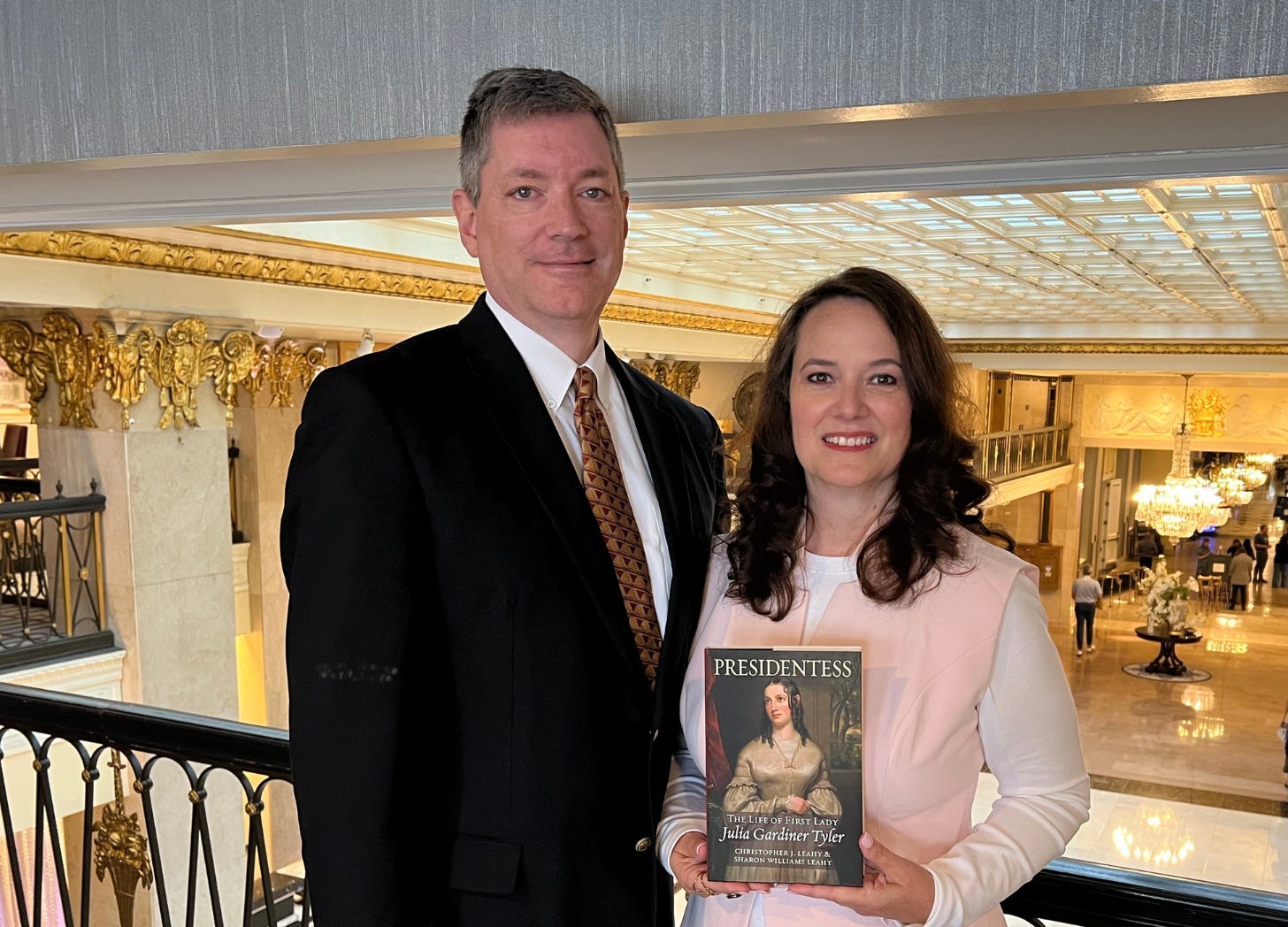
“Do you think you can prove it?”
That was the question historian Christopher Leahy posed to his wife, Sharon, an independent scholar, about 10 years ago when she was in the midst of translating letters written by Julia Gardiner Tyler, the wife of John Tyler, the 10th president of the United States. What was in question, though, was how past historians assessed one of the most character-defining moments of the young future first lady.
“Let me just go back … and tell you how it all came about,” Sharon Leahy tells East Wing Magazine in a recent joint-interview with her husband about the history-changing research they conducted for their co-authored, newly published biography Presidentess: The Life of First Lady Julia Gardiner Tyler.
It began, as Sharon Leahy explains, with the letters. They were difficult to decipher and required teaching herself how to read the script. When she unraveled the penmanship, a clearer picture emerged of Julia Gardiner Tyler.
It was plainly obvious that Julia Gardiner, at just 19 years old, had a beauty that captivated. Newly debuted in mid-19th century American society in the upstate New York town of Saratoga, the physical appearance of the woman, who a few short years later would become first lady of the United States, was the seed of a narrative that grew wildly beyond her control and took on a mythical existence. Unexpectedly, it took root long past her lifetime.
It is true, say the husband and wife authors, that her beauty on this multiday family outing in the summer of 1839 had men flocking to her side, including cordial encounters with then-President Martin Van Buren. People took notice at what the Gardiner family considered a very successful social debut of their eldest daughter.
So, too, did New York Herald newspaperman James Gordon Bennett—founder, editor and publisher of the widely circulated publication that served up a range of reporting alongside a steady stream of gossip about the city’s elites—and artist Alfred E. Baker, who crafted a caricature of Julia Gardiner as a satirical lithograph published in 1840 that would never be forgotten.
Dubbed The Rose of Long Island, the provocative (for the period) lithograph, later interpreted wrongly as an advertisement for a newly opened dry goods retailer, set off a scandal at the time. The caricature would become the foundation of a longstanding, negative historical narrative.
Interpretations of the lithograph down the line incorrectly asserted Julia Gardiner posed for the image, fueling recycled mischaracterizations of her personality—until now.
Later writers saw Julia Gardiner as a “publicity-seeking exhibitionist,” “hungry for attention,” and in one more modern characterization as the female pop icon “Madonna of her time” with a thirst for notoriety, the Leahys say.
“It becomes really important to understand that the image becomes this persuasive tool by previous historians and it gradually gets treated as evidence for a story that never actually was proven,” Sharon Leahy says, adding the topic initially was the focus of the academic paper “Not a Model: First Lady Julia Gardiner Tyler and New York City’s Print Culture” she wrote in 2018 and a critical piece of corrected history that contributed to their decision to write the full biography.
More than a century later as Sharon Leahy read through the correspondence, something didn’t add up between the letters and assertions that Julia Gardiner secretly posed for the lithograph. She turned to her husband and said, “I don’t think she did that.”
Listening closely to his wife, Christopher Leahy, the author of the 2020 biography President Without a Party: The Life of John Tyler, asked, “Why?”
“She’s so square,” Sharon Leahy recounts. “She would never do that.”
The letters revealed a young Julia Gardiner running every decision through her imperious mother, Juliana, and father David. That triggered further investigation of evidence and from where it came. The result, Sharon Leahy says, was a feeling that the historiography was “not quite supported.” That’s when she, indeed, sought to “prove it.”
The making of the myth
Instead of looking for proof in the family papers, Sharon Leahy focused on the artist, Alfred E. Baker, who owned a New York City lithograph shop on Wall Street.
Two well-known books—The Island, published in 1958 by prolific writer Robert Payne, and historian Robert Seager II’s 1963 dual biography of John and Julia Tyler, And Tyler Too, misstate that Julia Gardiner posed for the advertisement. It’s an essential paper trail of history that the Leahys show took a wrong turn. Payne starts the erroneous characterization and Seager repeats it. Modern technology that previous authors did not have at the time allowed Sharon Leahy to zoom in and view the publication date of the original lithograph—1840.
“This technology shows us that he made a mistake,” the Leahys write.
That mistake “obscured” Julia Gardiner Tyler’s real life, the Leahys say. The narrative painted Julia Gardiner Tyler as a young “coquettish” woman, an attribute that past historians assert motivated her to pose for what they believed was an advertisement. It was not, according to the Leahys. In fact, the The Rose of Long Island lithograph is akin to a modern day meme. Yet, these personal characteristics are what the previous historians say guided her behavior in Washington both before and after she married the sitting president of the United States.
Seager mistakenly wrote the publication date of the lithograph was 1839 and he stated unequivocally it was an ad for the dry goods store. After closely scrutinizing the image, the Leahys argue the image was never an ad to begin with because the dry goods store wasn’t open until 1840. Had either Payne or Seager been able to determine the correct publication date of The Long Island Rose, the character assessment of the first lady might have been different, the Leahys say.
A young, fleeting first lady
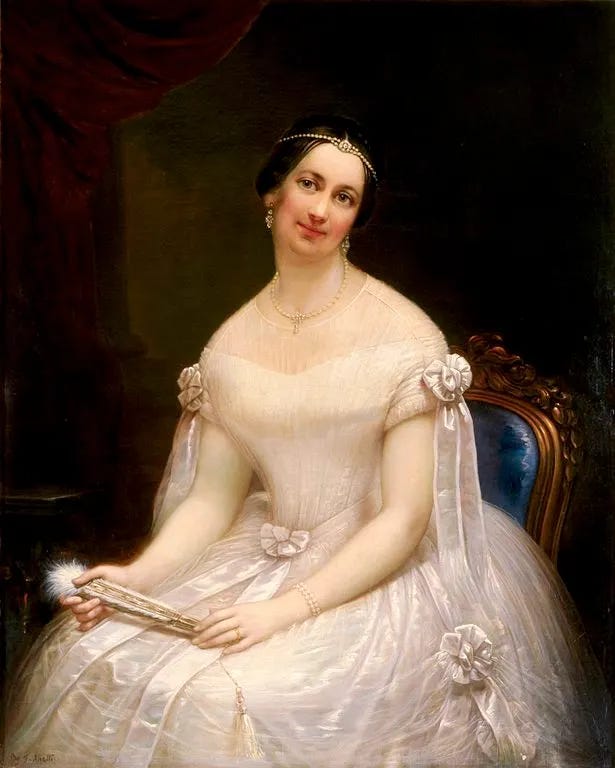
Julia Gardiner Tyler, 30 years younger than John Tyler, would go on to become the first bride of a sitting president. She only served in the role for eight months and was the first, first lady to donate her Francesco Anelli wedding portrait to the White House inaugurating the historically significant custom of hanging portraits of former first ladies in the Residence. The Leahys are the first scholars to closely examine this facet of Julia Gardiner’s life.
Her post-White House life, as documented by the Leahys, demonstrates the unexpected transition of a Northern woman to Southern life as her husband’s plantation mistress. John Tyler owned roughly 50 enslaved people. Later, his wife navigated the complicated landscape left in the aftermath of his death after a stroke. John Tyler aligned himself with the Confederacy, labeling him the “traitor president” while leaving his widowed wife, who also defended the institution of slavery, to raise their seven children while extended family were situated in the North as the Civil War broke out. Later in her life, the Leahys show how Julia Gardiner Tyler attempted to rehabilitate her family’s name by reentering Washington society as a respectable former first lady and even securing a pension as a widowed former first lady, a congressional action taken in the wake of the Abraham Lincoln assassination.
“Indeed, practically every aspect of her life, including her accomplishments as first lady, has been viewed through the lens of the so-called scandal of the lithograph,” the Leahys write.
Presidentess is the first biography of Julia Gardiner Tyler since the 1963 publication of Seager’s And Tyler Too. Modern technology pinpointing the correct date of The Rose of Long Island lithograph and the Leahys’ access to previously unused, recent primary resources that were unavailable to Seager point to Julia Gardiner not secretly posing for an advertisement.
For decades, Sharon Leahy says, the Julia Gardiner Tyler anecdote evolved into a character diagnosis.
“Its survival into the modern retellings just goes to show you how vivid a story can outlive that evidence that is behind it or not behind it in this case,” she says. “So once that foundation has cracks in it, you start to have to understand that you need to look at what else is built on top of that foundation. So addressing that lithograph and the story around it was the biggest fulcrum to move towards understanding this person who she really was.”
The erroneous characterization had an outsized impact on the first lady’s legacy overshadowing her contributions to her husband’s presidency (lasting less than one term) and her true character of extraordinary adaptability and resilience, the Leahys say.
“Julia understood that the White House social scene could be used as a political arena.”
—Christopher Leahy
“Julia understood that the White House social scene could be used as a political arena,” Christopher Leahy says, adding her savviness led her to lobby key congressmen on her husband’s policy to annex Texas. In fact, they document how Julia Gardiner Tyler sat in the House gallery as the Texas annexation debate ensued. Later, a series of caricatures capturing her image associated with the annexation were printed, marking the first time a first lady had been publicly linked to a policy during a presidential election campaign. “It’s pretty significant,” he notes.
There is a lesson, too, in how The Rose of Long Island lithograph and an unrestrained press impacted the young Julia Gardiner.
“That early experience really becomes important later because she learns that newspapers can really establish, but they can also really damage and hurt your reputation,” Sharon Leahy says, adding “they can also rehabilitate it.”
Christopher Leahy hopes what readers take away from their holistic biography of Julia Gardiner Tyler on this 250th anniversary year of the founding of the United States is more than her personal story. It’s a story about the American presidencies and how first ladies provide a “broader understanding of the people who actually make American history,” he says.
The disgraced President Tyler and his short tenure might have been considered forgettable. Yet, Sharon Leahy adds, what is discovered in the Gardiner-Tyler family papers is how Julia Gardiner Tyler lived through major epochs of American history and she documented all of it.
“Those stories are there,” she says. “And they’re much better than the mythology that’s been manufactured over the years.”