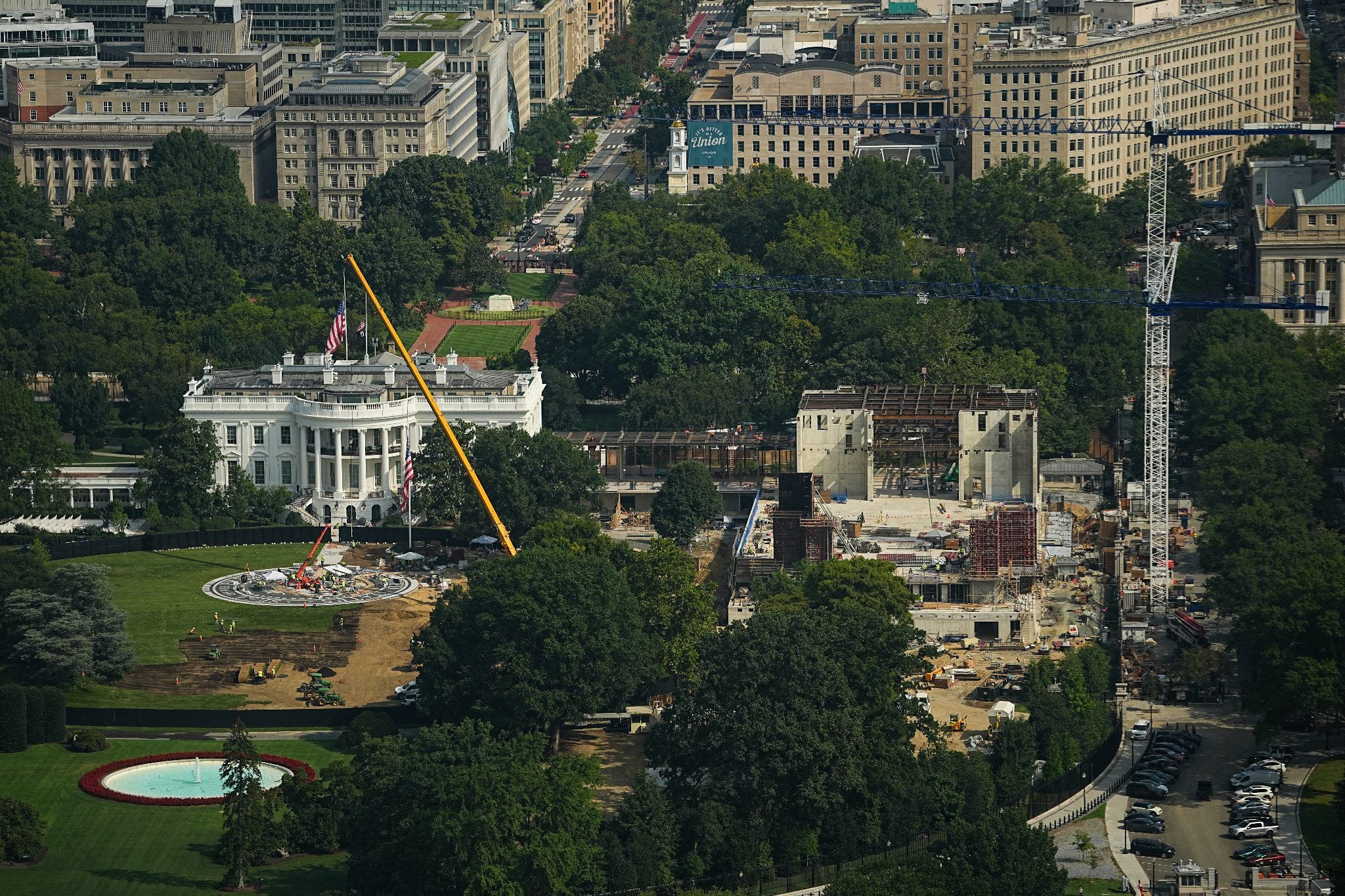
Construction can continue on the immense White House ballroom a divided Supreme Court ruled on Monday. The decision, however, came with sharp criticism from Chief Justice John Roberts who dissented, calling the construction “likely illegal.”
But legality of the construction was not what the court was deciding in this latest round of the legal fight over the $400 million, 90,000-square-foot ballroom. In a 5-4 vote, the majority said the preservationist case against the administration lacked standing, or a legal right, when it claimed an expert from the preservation community would be harmed by the aesthetics of the newly designed East Wing after it was abruptly demolished last October.
The National Trust for Historic Preservation, the plaintiff and nonprofit organization chartered by Congress that maintains, enhances and protects historic places, sued President Trump and other agencies of the government on December 12, 2025, in response to the demolition. To establish its standing to bring this case, the Trust relied on a declaration by Washington D.C. resident and Trust member, Alison Hoagland, who contended viewing the finished ballroom would cause her harm as a result of her “aesthetic, cultural, and historical interests” because she finds the “scale,” “height,” and “massing” of the government’s design distasteful.
The majority of justices, who considered past precedent-setting environmental cases, wrote in the ruling that it “repeatedly held that mere offense, disagreement, or distaste does not qualify as a concrete and particularized injury.”
The Supreme Court decision allows the ballroom construction to continue, blocking a lower Washington, D.C. district court’s order earlier this year that would have halted construction of the above-ground aspect of the work that had recently started taking shape. United States District Judge Richard J. Leon (a George W. Bush-appointed judge) in his ruling, allowed underground construction to continue while the Trump administration appealed the decision, but maintained that explicit approval for the above-ground project was needed by Congress. Roberts allowed the construction to continue in a decision in late August while giving the Supreme Court time to consider the case.
In his dissent with three Democratic appointees, Roberts argued that the majority’s consideration of Hoagland and the environmental cases didn’t hold up.
“Certainly one may enjoy a river not just by looking at it but also by swimming in it and hiking along it. But the principal way a person enjoys a historic building or object is by looking at it,” Roberts wrote, noting that the White House is not simply a historic building, but an iconic one.
He went on to explain:
“The White House is not just any building, and—when it comes to historic preservation—Hoagland is not just any person. In failing to appreciate as much, the Court misconceives the plaintiff ’s injury, allowing the Executive’s likely infringement of the Legislature’s power of the purse and authority to regulate federal property in the District of Columbia to continue. Today’s decision is no victory for the separation of powers.”
The majority, though, added that the government would suffer irreparable harm if Leon’s injunction were allowed to go into effect, citing numerous high-ranking governmental officials “attesting to national security” harms if the ballroom construction were halted above what has now been described by the administration as a five-story-deep military complex.
President Trump on Monday hailed the court’s decision saying in a social media post, “We are living in the Golden Age of America, and this building will be one of the greatest ever constructed in Washington, D.C.”
He added his expectation that the building would be completed by summer of 2028.
In response to the Supreme Court’s decision, Brent Leggs, president and CEO of the National Trust said in a statement:
“We are deeply disappointed in the Supreme Court’s ruling today and respectfully disagree with the majority’s opinion on standing. It is noteworthy that the majority did not weigh in on whether the ballroom project was in fact legal.”
Leggs went on to say that Monday’s ruling is not the final decision on the merits of their case and does not resolve their fundamental argument “that each President is a temporary steward of the People’s House and does not have the unilateral authority to demolish and redesign it without the approval of Congress.”
While the ballroom construction has been argued in the courts, the administration revealed it had a 250-person crew “working 20 hours a day, 7 days a week,” and that “the Project is 65% complete in its entirety, and moving quickly toward total completion.”
Members of Congress in a court filing last month asserted the administration skirted their authority saying, “Congress never appropriated funds to carry it out.”
Lawmakers added that if the president believes national-security concerns require the project then “he can bring those concerns to Congress and convince Congress to authorize the project and appropriate the requisite funds,” they said in the filing.
Inside, the bunker allows for bomb shelters, state-of-the-art hospital and medical facilities, protective partitioning between all areas of the building, top secret military structures and equipment, military-grade venting, a single integrated air conditioning and heating system, sniper nests, and a drone port on top, elevated by the structure of the ballroom, to protect the White House and surrounding region from aerial attacks, according to the administration in a court filing.
Above ground, the ballroom construction is expected to also allow for a new suite for the Office of the First Lady. While other former first ladies have publicly spoken out against the destruction of the East Wing—the formal workplace of the first lady and her staff since Rosalynn Carter professionalized it in 1977—First Lady Melania Trump has stayed silent on her husband’s projects remaking areas of the White House complex. It was reported in the immediate aftermath of the East Wing demolition that she privately expressed her concerns telling associates that “it was not her project.”
In addition to the East Wing Modernization project housing the ballroom, Mr. Trump has renovated the Rose Garden by replacing the grass with patio pavers and is currently installing a helicopter landing pad on the South Lawn of the White House.
But the White House building is something to behold. Roberts in his conclusion invoked Winston Churchill who once remarked “we shape our buildings, and afterwards our buildings shape us.”
That, Roberts added, “was all the more reason to ensure that those responsible follow the rules in deciding what to tear down and what to build up at the People’s House.”
Calendar
Sept. 2, 2026
Cookin’ with Congress: Famous Punches & Mocktails of the White House
The National First Ladies Library & Museum presents historian and creator Bennett Rea for a lively virtual event from 7 to 8 p.m. ET on September, 2, 2026, exploring famous punch recipes, White House entertaining traditions, and creative mocktail variations inspired by presidential history. Read more
Sept. 8-10, 2026
Presidential Sites Summit
The White House Historical Association will host the Presidential Sites Summit at the historic Mayflower Hotel in Washington, D.C. on September 8-10, 2026.
This convening will bring together leaders and staff from presidential sites nationwide, including birthplaces, childhood homes, libraries, museums and alma maters—to reflect on the America 250 semi-quincentennial celebrations and accomplishments and look to the future. The program emphasizes lessons learned, future collaborations, and strategies for sustaining relevance in a dynamic cultural landscape. Read more
Sept. 11, 2026
Legacy Lecture: Unity, Duty, and Resolve: The Enduring American Spirit
The National First Ladies Library & Museum on September 11, 2026, presents a special Legacy Lecture commemorating the 25th anniversary of the September 11 attacks with an online moderated discussion featuring Anita McBride and Stephanie Bohnak. The event will take place from noon to 1 p.m. EDT. A former Chief of Staff to First Lady Laura Bush and longtime White House advisor, McBride brings unique insight into the role of leadership and public service during one of the most defining moments in modern American history. The discussion will explore themes of leadership, service, resilience, and national unity in the aftermath of September 11, 2001. Read more
Sept. 12, 2026
Night Walk Living History: Remembering Julia
The Ulysses S Grant National Historic Site will feature a living history with performers that will include a portrayal of Ulysses S. Grant who will talk about his love for Julia. This outdoor living history event on September 12, 2026, will take attendees back to the time following the White House years and World Tour, as the Grants visit White Haven for what would be the last time in 1883. Guests will be guided to different parts of the White Haven grounds to hear stories from several of the people who were most important in Julia’s life.
The event is free, but reserved chairs are limited to the first ninety who register. Reservations open on August 1 and can be made by calling 314-842-1867 ext. 230. Read more
Sept. 16, 2026
Reimagining Mary Todd Lincoln with Lois Romano, Lucas McMahon & Carolyn Ryan
P&T Knitwear in New York City will welcome author Lois Romano from 6:30 to 8 p.m. on September 16, 2026, to discuss her book An Inconvenient Widow; a revelatory new biography of one of the most misunderstood and vilified First Ladies in American history: Mary Todd Lincoln.
Romano will be in conversation alongside Lucas McMahon, Executive Producer of Broadway’s hit comedy, Oh Mary!. The conversation will be moderated by Carolyn Ryan, Managing Editor of The New York Times. Read more
Sept. 17, 2026
Third Thursday: Vital Voices with Andrew Och
The National First Ladies Library & Museum presents Third Thursday: Vital Voices with Andrew Och, an in-person presentation by the author also known as “The First Ladies Man.” Och will offer a fascinating look at how America’s first ladies have supported military veterans throughout U.S. history. This special Third Thursday program from 6:30 to 8 p.m. on September 17, 2026, explores the efforts of First Ladies—including Florence Harding, Jill Biden and others—who championed veterans and military families across American history. Wine and cheese will be served. Read more
Sept. 29, 2026
White House History Live: Presidentess — The Life and Legacy of First Lady Julia Gardiner Tyler
The White House Historical Association’s White House History Live presents the virtual event “Presidentess—The Life and Legacy of First Lady Julia Gardiner Tyler” at 5:30 p.m. ET on September 29, 2026.
Julia Gardiner Tyler was not a curiosity or a contradiction—she was a force. As the first “bride of the White House” and one of the youngest first ladies in American history, she consciously shaped her public role, skillfully used newspapers, portraits, and fashion, and expanded what a first lady could be before the role had rules. Authors Christopher J. Leahy and Sharon Williams Leahy reveal how Julia navigated the undefined early presidency, managed visibility with intention, and transformed personal and political challenges into influence. This virtual event will be live streamed on the White House Historical Association’s Facebook and YouTube pages. Read more
Sept. 30, 2026
Second Private Tour of the Val-Kill Furniture Exhibit at the Met
The Eleanor Roosevelt Center at Val-Kill presents an exclusive private tour on September 30, 2026, of the Metropolitan Museum of Art exhibit on Val-Kill Industries furniture for some of its supporters. This tour will be led by the exhibit curator, Alyce Perry Englund, and Eleanor Roosevelt’s great-granddaughter, Sara Boettiger. There will also be lunch included after the tour at the American Wing Cafe inside the museum. Read more
Send calendar items, press releases and announcements to jtaylor@eastwingmagazine.com.


