


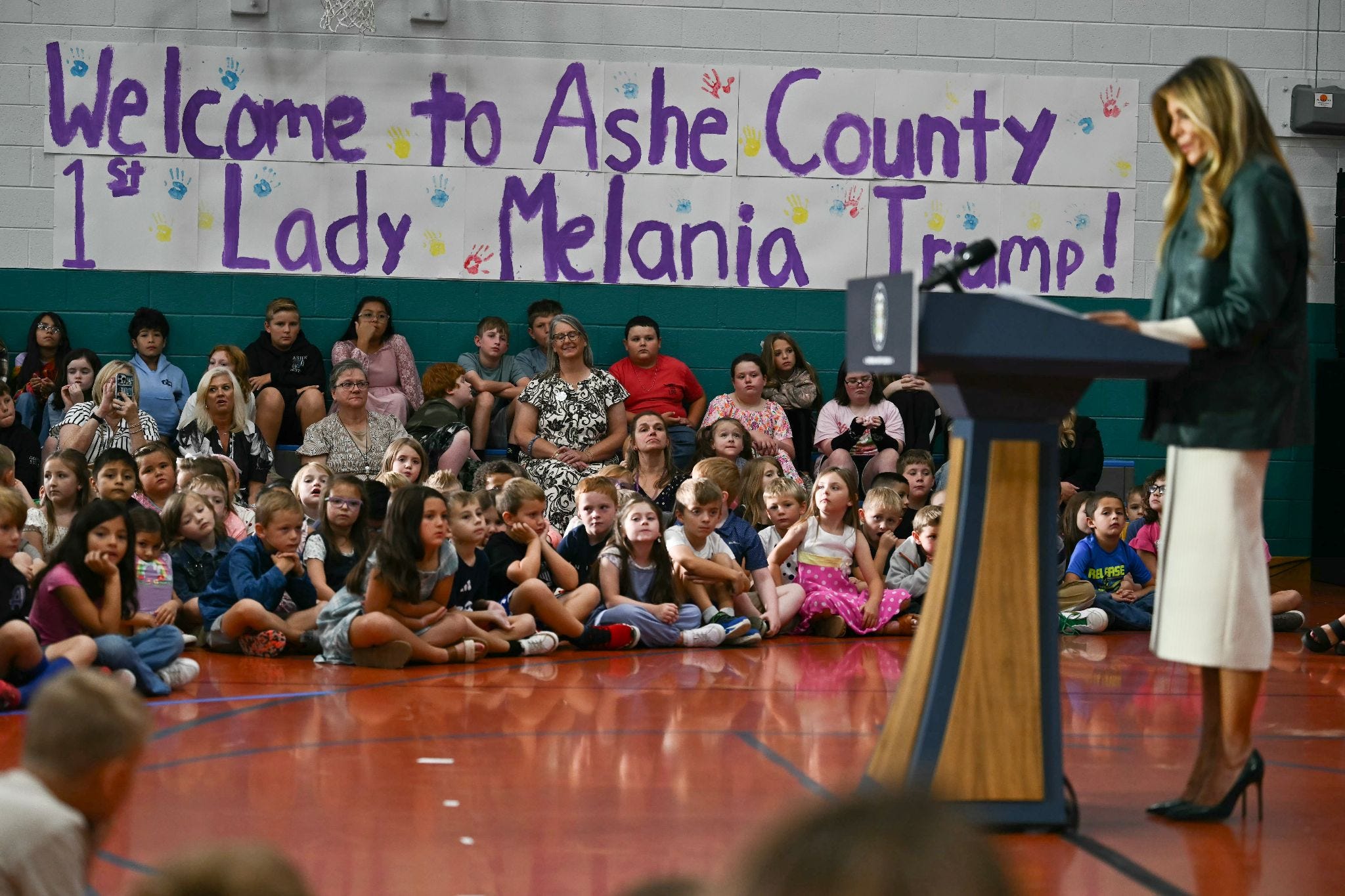
Nearly two years after Hurricane Helene spun a tropical storm through North Carolina’s Ashe County unleashing catastrophic floods killing more than 100 people, the community has come through the devastation and is looking to the future.
First Lady Melania Trump, who visited the area in January of 2025 just days after her husband President Donald Trump’s inauguration, returned on Tuesday visiting Mountain View Elementary School in North Jefferson, North Carolina, hailing the community and its leaders for their resilience and for their focus on technology and education.
“Knowledge is power. Knowledge gives everyone in this town the chance to move beyond Helene and to imagine new possibilities,” Mrs. Trump said in her remarks. “It gives the next generation the choice to help create a beautiful world in the future—a better America.”
Before a packed gymnasium of students and staff, Mrs. Trump also announced a partnership with the technology company Nvidia to bring more artificial intelligence to the school. Specifically, Nvidia will provide StudyFetch 4-year subscription licenses for 1,500 students in Ashe County School District and 100 Jetson Nano Developer Kits to Mountain View and other Ashe County Schools.
The Kit is a small, low-power, agentic-ready A.I. computer. A common use is powering small, autonomous robots by processing data locally on the robot rather than relying on a remote cloud server.
As part of her visit, Mrs. Trump toured classrooms.
“I cannot wait to see what you have been learning. I am especially excited to hear about your work with A.I.,” the first lady said in her remarks.
Mrs. Trump’s announcement comes amid a national debate on the implementation and use of A.I. across every sector of society. Specifically, schools at every level have a mixed approach on the use of A.I. On Tuesday, The New York Times reported on the findings of a Massachusetts Institute of Technology report released in August that said university students are using A.I. for “everything, including cheating” and that A.I. is triggering “cognitive surrender.” And earlier this month, a researcher at the A.I. company Anthropic resigned, warning about the dangers to humanity from its industry’s own technology voicing doomsday-like scenarios.
Some universities have set up guardrails around A.I. The University of Chicago has banned A.I. in certain social science courses, while banning phones, tablets and laptops in first-year classrooms. The Ohio State University, on the other hand, is integrating A.I. into all majors and training students how to use it and when not to, according to The New York Times.
Back at Mountain View, the public elementary school located in rural northwest North Carolina, serves approximately 566 Pre-K through sixth grade students with small classes where the student-to-teacher ratio is 14:1. Mrs. Trump acknowledged how after the storm Ashe County Schools—including Mountain View—closed for two weeks, with students returning after 33 days. Ashe County Schools broadly became part of the community’s emergency response infrastructure, publicly described as essentially the “first line of defense” during the crisis. The school, not significantly damaged, opened as an emergency child-care center the day after the storm, and was subsequently designated as community distribution sites for supplies.
It is in this rural landscape—over 400 miles of mountainous terrain—Ashe County Schools Superintendent Eisa Cox noted on Tuesday that A.I. could serve as a tool to solve “authentic” problems in their own community. Mrs. Trump’s visit was an opportunity to see how the school, known for its strong STEM program, is incorporating technology in the classroom including the use of artificial intelligence.
The first lady visited three classrooms. In one of them she took a question about students using A.I. given the concerns about the technology.
“I think they need to learn. We need to lead as a A.I., as a country, and we could see now what they’re learning, and it’s very important,” Mrs. Trump said. “Of course, they need to be vigilant, as well. But this is our future, and we need to guide them and teach them what, what is available. If not, they will stay behind, and we need to be the first in United States to lead.”
Her first visit was to Mr. Preston Robert’s fifth-grade science classroom where the first lady listened to a lesson on how lungs work. The kids used balloons and a bottle to simulate how lungs inflate. They then used A.I. to turn the model into a video simulation.
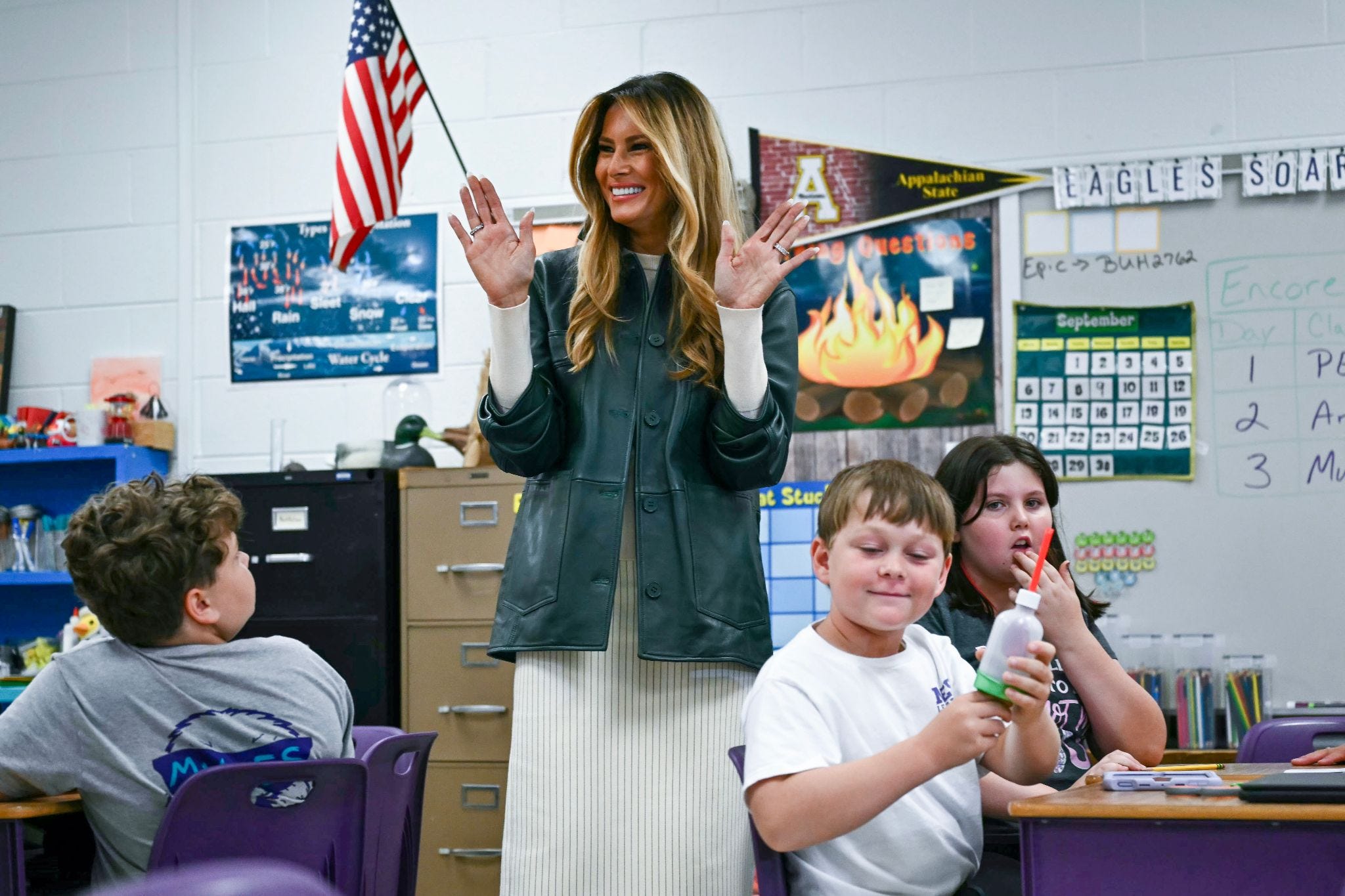
In another classroom, students demonstrated Nvidia/StudyFetch Robotics Arms. Students program robotic arms to complete tasks such as stacking blocks. Mrs. Trump joined a group at their table where they explained how the robotic arm worked. At another robotic table she expressed her amazement of students.
“You are amazing in what you do,” she said, praising them after learning they worked in teams of two, noting it was smart as each person has their own talent. “You are very smart and you have a big future guys. … You can do anything. Anything is possible. The sky is the limit. Never give up and study hard.”
The first lady encouraged all of Mountain View’s students to take their education seriously, to stay curious and to challenge themselves.
“Dream big and use these A.I. tools to build something never created before,” she said. “Maybe one of you will create the next great robot. And if you do, make sure you bring it to the White House to show me!”
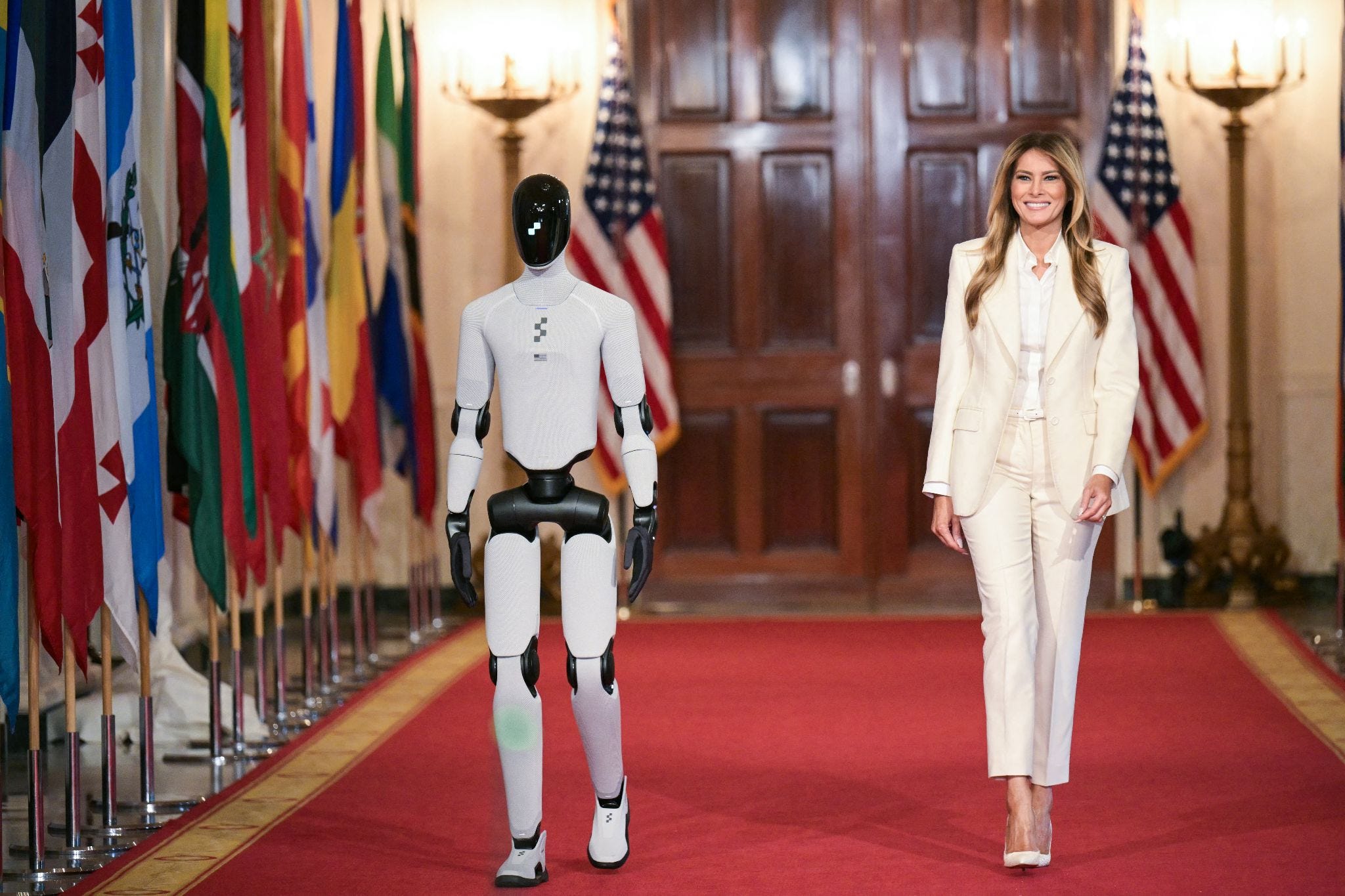
Mrs. Trump’s robot comment harkens back to the first lady’s Fostering the Future Together Global Coalition Summit that took place at the U.S. Department of State and the White House last spring with 45 spouses of global leaders in attendance. The gathering captured headlines and sparked some controversy about A.I. after a humanoid robot walked into the White House East Room alongside Mrs. Trump.
At the time, Randi Weingarten, the president of the AFT, criticized the first lady and her Fostering the Future Together initiative, urging that A.I. not replace human teachers with artificial intelligence-powered robots. Later, Mrs. Trump clarified her past remarks when she wrote in an opinion piece published last April about how A.I. is “a great equalizer,” believing it can level the educational playing field for all children when, for generations, only wealthier families could afford tutors and specialized programs. She also wrote how teachers would remain the foundation of education, but that the technology could serve students in remote or under-resourced communities.
In June, Weingarten continued to express her concerns over A.I. when she stated what artificial intelligence doesn’t change “is the essential purpose of education: teaching students how to think.”
“Some of the most valuable skills in the A.I. age—like problem-solving, communication, collaboration, adaptability and ethical judgment—require the ability to apply knowledge,” Weingarten said. “But A.I. is increasing so-called cognitive offloading; rather than working through a challenge, students turn to a chatbot for an effortless answer.”
As a way forward, Weingarten offered her own plan to boost student learning and success by taking on the technology and calling for: limits on screens and student-facing A.I., an enforceable privacy standard for A.I. in schools, more project-based learning, protections for intellectual property and a tax on Big Tech’s earnings to compensate the country for the consequences of “this tech takeover.”