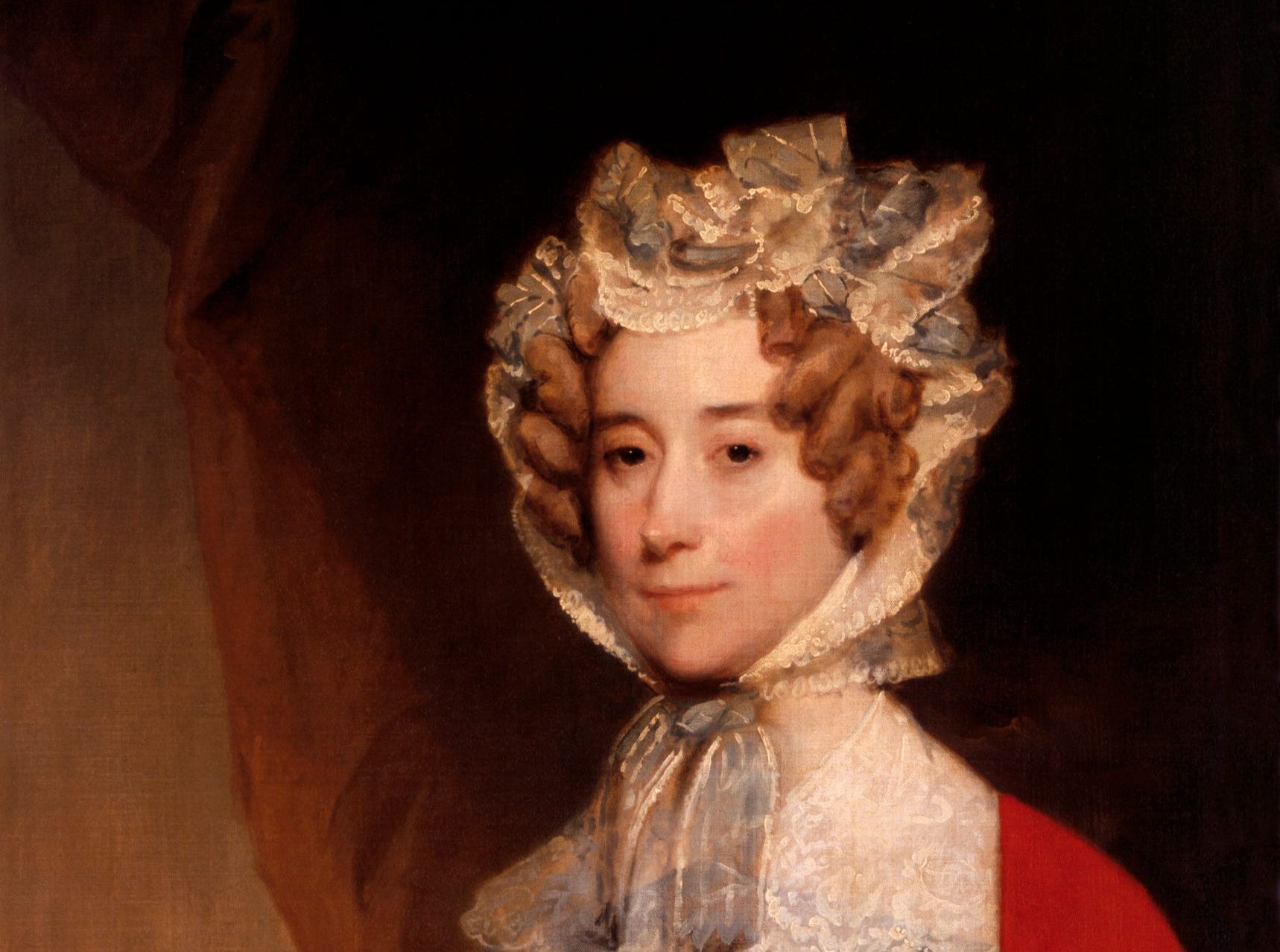
Louisa Catherine Adams Was Somebody
In Pursuit essay by author Louisa Thomas spotlights the woman who was First Lady Louisa Catherine Adams.
Marrying into a famous political family has its challenges. And as the daughter-in-law to the outspoken and respected Abigail Adams, wife of America’s second President John Adams, Louisa Catherine Adams found settling into the White House more than 20 years after her father-in-law’s presidency, notably unsettling.
Readers learn quickly in the latest In Pursuit essay “True Strength Begins With Self-Knowledge and Reflection” by Louisa Thomas that the wife of the sixth U.S. president, John Quincy Adams, was put off by the “disrepair” of the White House and overcome by feelings of displacement.
Thomas, author of “Louisa: The Extraordinary Life of Mrs. Adams,” illustrates this with an excerpt from a letter Mrs. Adams wrote to her son saying, “There is something in this great unsocial home which depresses my spirits beyond expression … and makes it impossible for me to feel at home or fancy that I have a home anywhere.”
Scholars note that First Lady Louisa Adams’s White House tenure from 1825-1829 was not particularly remarkable. Contributing to that was, as Thomas writes in her essay, how the John Quincy Adams presidency was “doomed” as a result of his narrowly-won election. Louisa Adams “was not like her mother-in-law, Abigail, who was John Adams’s wise counselor throughout his life,” Thomas said.
But what matters, according to Thomas, was Louisa Adams’s ability (often in private moments) to help her husband, self-described as “cold” and “austere,” ascend the political ranks through her warmth and social prowess when he served as secretary of state under President James Monroe in the years leading up to his presidential election. During that time, Louisa Adams was known for parlor gatherings, balls and “tea parties” as a way to communicate to her husband the political pulse around them.
“John Quincy needed allies in Washington. Relationships mattered. That was not his strength, but it was his wife’s,” Thomas writes.
Today, people advocating for the legacy of the Adams family, including Louisa Adams, believe she has been underestimated by Washington, at times by her own husband, and overlooked to a great degree by history. It is essays like this that help reveal her true influence.
“She was a political strategist, a writer, a woman of remarkable resilience who traveled across war-torn Europe alone with a young child to reach her husband,” Jackie Gingrich Cushman, president of The Adams Memorial Foundation, recently told East Wing Magazine. The foundation is currently pursuing a Washington, D.C., memorial commemorating the Adams family. “She lobbied quietly, and brilliantly while publicly deferring to convention. Louisa Catherine was everything John Quincy was not in human terms. He had the ideas; she had the relationships. He understood history; she understood people. That balance was not incidental to his career. It was essential to it.”
It was years later, though, when Thomas described Louisa Adams finding her voice as her husband found his way back to Washington, D.C., after his presidency when, unbeknownst to Louisa Adams, he won election in 1830 to the House of Representatives. He was the first and only president to date to serve the country in that fashion.
Louisa Adams, according to scholars, was the first foreign-born U.S. first lady. Her mother was of British descent and her father was American. In her later years, Thomas said, she wrote poetry and plays. She authored “Narrative of a Journey from Russia to France” in 1835, which Thomas notes recounts her “harrowing tale of her travel through Europe during the Napoleonic Wars.” But it was a letter turned personal memoir called “Adventures of a Nobody,” which has experts in agreement that Louisa Adams recognized within herself that she was indisputably somebody.
“Louisa’s self-knowledge came through writing. She sat down to write a letter to her son and discovered she had a story worth telling, that she was, as she put it, ‘one, who was.’ It’s not loud. It’s simply true,” Cushman said.
The foundation, Cushman added, is building the proposed memorial because of what the Adamses believed, what they sacrificed, and because who they were “still speaks to us today.”
Louisa Adams’ place in the family’s legacy shows, Cushman said, that “she mattered greatly.”
The In Pursuit essay series is a bi-partisan initiative created by the Washington, D.C.-based organization More Perfect with the goal of distilling past presidents’ and first ladies’ wisdom about leadership and democracy.


