Lady Bird Johnson Found Her Voice By Overcoming Her ‘Terror of Oratory’
Guest Column by Melody Lehn

Beginning in high school, Lady Bird Johnson suffered from severe public speaking anxiety. The idea of giving a speech left Johnson with what one journalist called a “terror of oratory.” So great was this terror that Johnson expressed relief when her grade point average slipped just enough to place her out of range for the valedictorian or salutatorian honor, both of which would have required a commencement speech. Biographer Jan Jarboe Russell writes that Johnson later remarked, “I had enough pride to want to amount to something, but not enough to pay the price to make a speech.”
Johnson was certainly not alone. An unusually high number of Americans—up to 75%, according to some studies—report experiencing some degree of apprehension about the prospect of addressing a public audience, defending arguments, and fielding questions.
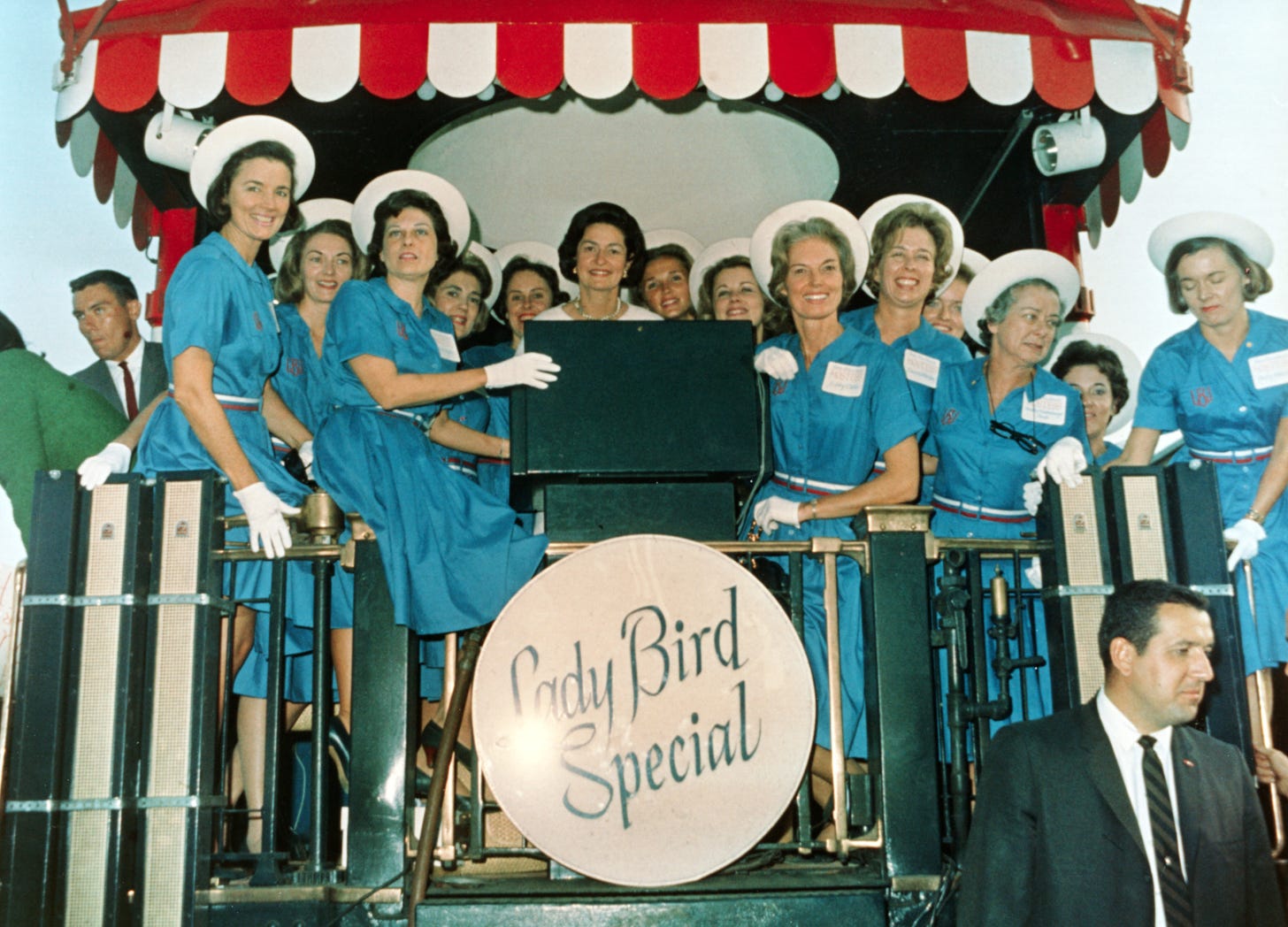
Notwithstanding her well-documented trepidations, Lady Bird Johnson left an indelible mark as a rhetorically active first lady. She kept pace with the groundbreaking precedents set by Eleanor Roosevelt while also making the role her own. As Shannon McKenna Schmidt reminds us in her new book You Can’t Catch Us: Lady Bird Johnson’s Trailblazing 1964 Campaign Train and the Women Who Rode with Her, Lady Bird made history as a campaigner. And even academics appraised her favorably during her tenure. One communication journal described Johnson as “undoubtedly the best feminine speaker the [Democratic] party has” in 1964. Just three years later, the journal Today’s Speech (now Communication Quarterly) listed Johnson among the 60 outstanding female rhetors in American history.
Taken together, these disparate facts and observations raise an intriguing question: How did such a reticent and frightened speaker become such an accomplished and capable public rhetor, campaign surrogate, and political figure in her own right?
My recent article for the Journal for the History of Rhetoric takes up this question. I have traced the answer to Johnson’s time with the Capital Public Speaking Class, a remarkable forum for women from very different backgrounds to come together, exchange ideas, and learn with and from one another.
The Capital Public Speaking Class originated as “Practical Platform Speaking” taught by Smith College alumna Jessie Haver Butler. Butler was a well-known suffragist, lobbyist, lecturer, speech teacher, and she was the author of Time to Speak Up: A Speaker’s Handbook for Women (1946). Butler trained in public speaking with the American Woman’s Club while in London during the 1920s. On returning to the United States, she taught 33 public-speaking classes throughout New England between 1930 and 1935, pursued further education at George Washington University under Professor Willard Hayes Yeager, and later attended meetings of the Speech Association of America (now the National Communication Association).
By 1951, Butler had relocated to California to teach at Mt. San Antonio College and Hester Beall Provensen had taken over the newly retitled “Capital Public Speaking Class.” Provensen was a longtime speech professor at the University of Maryland, an active member of the Speech Association of America, a popular lecturer, and the first female commercial radio announcer in Washington, D.C. In addition to maintaining a rigorous schedule as a professor and private speech coach, Provensen invited Butler’s former students to form the “Capital Speakers Club” in 1951. Provensen imagined “a thoroughly practical and dynamic Speakers Club” that would meet regularly, hold luncheons, invite guest speakers, and build community as its members honed their public-speaking skills together long after a particular class had graduated.

At the urging of her husband—and perhaps inspired by Eleanor Roosevelt, who notably studied elocution with vocal coach Elisabeth Ferguson von Hesse—Lady Bird enrolled in the Capital Public Speaking Class in 1959. The class typically met twice a week at various local hotels, apartment buildings, and social clubs. Washington correspondent Dorothy McCardle reported that the course regularly had a waiting list of women eager to enroll. According to journalist Virginia Green, 21 other women took Johnson’s class with her, including “a Senator’s wife, several diplomats, an opera singer, a company president and a college professor.” The Kenwood Country Club hosted Johnson’s class graduation on March 31, 1959. Before receiving a diploma, the future first lady delivered a final three-minute speech focused on her life trajectory following the December 1941 attacks on Pearl Harbor.
The essential purpose of her speech instruction was, as Provensen once put it in an interview with Jane Eads, “to teach women to speak in public, and to organize their thinking and present their material effectively.” To fashion her kind of female speaker, Provensen attended to different methods and genres of speaking as well as to the cultivation of the speaker’s ethos and platform skills: “My students learn methods of sustaining audience interest, how to make informative, persuasive and entertaining speeches, and speeches of welcome, presentation and acceptance of gift. They learn proper dress and deportment for platform appearances.” Provensen also elevated listening in the curriculum. Many students sought to improve their listening skills, particularly as they related to following the nuances of political discourse and debate. Peggy LeBaron, the wife of the assistant secretary of defense for atomic energy, told Dorothy McCardle that she enrolled in a class with Provensen to learn to listen and, “to listen in on Congress at that!” The course, in other words, developed both rhetorical capacities and civic identities in its participants.
Some skeptics did not quite grasp the fact that Provensen’s educational venture was, in fact, a multicultural learning experience for her students. The commentator George Dixon once rather unflatteringly described Provensen’s students as “matriculating matrons.” However, examination of newspaper coverage surrounding both the Capital Public Speaking Class and the Capital Speakers Club reveals diversity at work, diversity that is reflected in Lady Bird Johnnson’s experience as well. A striking aspect of Provensen’s course was the varied composition of its members and the equally varied topics they chose to address. Unsurprisingly, Provensen also saw listening as an avenue for developing cultural competence and sensitivity. As she had told Jane Eads in an earlier interview, a course that admittedly began to help “wives be of assistance to their husbands if need be” evolved into a forum for women not only to “learn to talk on vital issues to themselves” but also to “develop a new understanding of regional and world problems by listening to their fellow students.”
In any given class, then, students represented differences across as well as beyond party affiliation. Under Jessie Haver Butler, the course met at both the Democratic Party headquarters and the Republican Party headquarters. Despite being a devoted Roosevelt ally, Butler, as did Provensen, explicitly saw herself as a “bipartisan teacher.” In the same class, one could find Jane Ickes (a Democrat and the wife of the former secretary of the interior under Franklin Delano Roosevelt) seated next to Louella Carver Dirksen (a Republican and the wife of a lawmaker from Illinois) listening to another classmate, the former Countess Marie Felice Sieminski née Czarkowska-Golieska, deliver an impassioned speech against communism. As it happens, Lady Bird Johnson took the course with Louella Dirksen, whose husband was Lyndon’s Republican rival in the Senate.
Women in Provensen’s courses also varied by ethnicity, nationality, and, in cases like Marie Sieminski’s, familiarity with the English language. Several international diplomatic wives not only completed a course but also served as officers in the Capital Speakers Club. In 1956, the executive board included ambassadors’ wives from Iraq, the Netherlands, and Thailand all working together to plan the club’s agenda and events. The club elected Constance V. Batoon—the wife of the Philippine cultural attaché—to serve as its president three years later. Provensen also frequently brought in non-American women as speakers, listeners, and guests of honor at class and club meetings, luncheons, and teas.
Accordingly, Provensen’s students learned the importance of adapting their ideas to a diverse audience’s needs and interests. Speech topics were often tailored to the club’s international students and visitors, and speakers sometimes (though not always) raised truly thoughtful subjects in their addresses. Lady Bird Johnson’s classmate Mrs. M. S. Shaikh, the wife of the Pakistan embassy’s counselor, delivered a graduation speech focusing on religious tolerance, calling for peace whether people be “Christian, Hebrew, or Islamic.” Students delivered a series of speeches about Egypt at a 1955 lunch honoring Aziza Shuhri Hussein, the wife of the Egyptian ambassador. Mme Marie-Vera de Leusse, the French minister’s wife, heard orations about different fashion designers during a 1963 visit. And, in 1958, a luncheon celebrating Takako Debuchi, the wife of the Japanese ambassador, featured five three-minute-long speeches about civil defense and travel in the Middle East. Louella Dirksen even took inspiration from her experiences with the Capital Speakers Club and expanded her efforts into chairing the “International Speakers Exchange,” which circulated American goodwill abroad through the efforts of trained female speakers.
Some women involved in Provensen’s class and club were—or notably became—political figures in their own right, bringing a different kind of experience to the forefront of conversation. A concentration camp survivor in Europe during World War II and polyglot, Marie Sieminski spoke Polish, French, German, and some English when she emigrated to the United States. She completed Provensen’s course in 1951 and, in later years, served as a State Department protocol official. A Republican classmate in Lady Bird Johnson’s cohort, Pearl Carter Pace, served as the only woman appointed by Dwight Eisenhower to the Foreign Claims Settlement Commission. In one speech for Provensen’s class, Pace spoke candidly about sexism in an address about “male reactions to her own successful career.” Again, the women in Provensen’s course engaged topics representative of their diverse and sometimes difficult experiences as political wives, surrogates, appointees, and citizens.
“I became much more comfortable . . . because it was easy for me to believe that those people out there in front of me were very much like me. I didn’t have to be afraid of them.”
—Lady Bird Johnson
For Lady Bird Johnson, the class had a variety of documented benefits. According to the first lady historian Lewis Gould, Johnson achieved her goal by learning to “talk more slowly and to pitch her voice lower.” She also reported that the course yielded considerable benefits in confronting her apprehension, testifying: “I became much more comfortable . . . because it was easy for me to believe that those people out there in front of me were very much like me. I didn’t have to be afraid of them.” In spring 1960, Johnson experienced what was, to her, a significant accomplishment: she successfully delivered a planned introduction of her husband at a women’s conference. Furthermore, her exposure to different people and perspectives was vital given the kinds of diverse—and occasionally hostile—audiences she would later face as first lady, especially when campaigning throughout the South. As Johnson later told an oral historian, Provensen’s class gave her many “good hours” of exposure to “facets of the world” that she might not otherwise have encountered.
The Capital Public Speaking Class established a strong foundation for the woman who, within three years, would suddenly and unexpectedly become the nation’s new first lady. In the White House, Lady Bird Johnson continued working with Hester Provensen as her speech coach and detailed their close and fruitful working relationship in her bestselling 1970 memoir A White House Diary. Johnson’s unpublished recordings of her diary entries further document her pursuit of oratorical excellence with Provensen. By recovering and highlighting Lady Bird Johnson’s experience in the Capital Public Speaking Class, we are reminded of the resourcefulness and perseverance of our nation’s first ladies—unelected political spouses who nonetheless find themselves with a platform and a voice.


