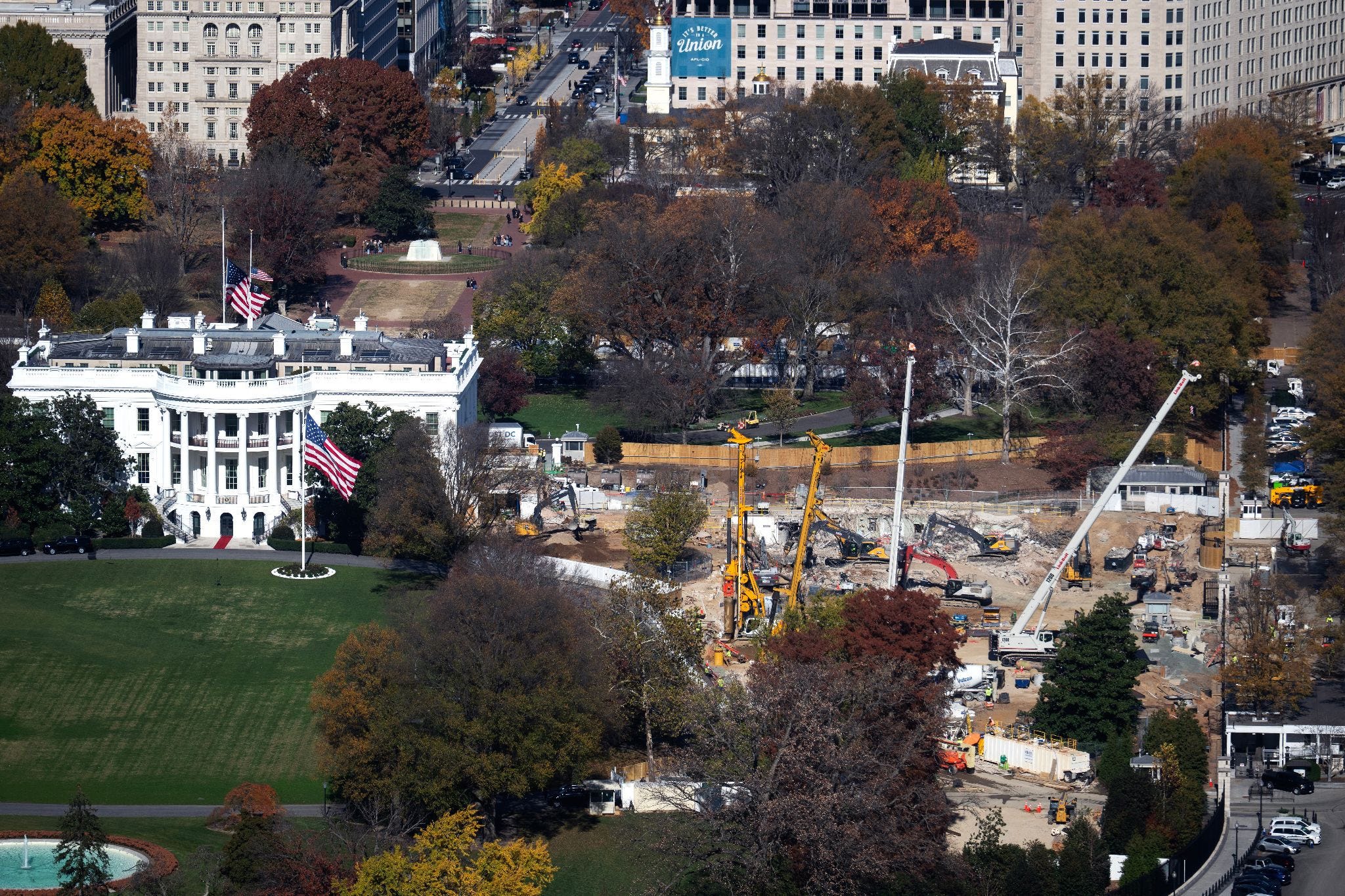
Judge: White House Ballroom ‘Construction Has to Stop!’
President Trump says he will appeal. Preservationist ‘pleased.’ And, former East Wing staffers relieved for now.

Work on President Trump’s proposed White House ballroom must stop and cannot continue unless Congress approves the project, a federal judge ruled Tuesday.
The decision came just two days before the National Capital Planning Commission—a federal panel that reviews projects in Washington, D.C., and that had received thousands of negative comments against the project—was set to vote on the planned $400 million, 90,000-square-foot East Wing that included the 22,000-square-foot ballroom.
President Trump was swift in his response to United States District Judge Richard J. Leon’s decision when he told reporters in the Oval Office Tuesday evening while signing an executive order meant to crack down on mail-in voting that he plans to appeal the judge’s decision and that he took issue with the fact that the judge thinks he needs congressional approval.
The National Trust for Historic Preservation, the plaintiff and nonprofit organization chartered by Congress that maintains, enhances and protects historic places, sued President Trump and other agencies of the government on December 12, 2025. The National Trust asserted in their lawsuit that ongoing construction of the White House ballroom is unlawful and asked the court to halt construction until the government complies with the law by going through the legally mandated review processes, including approval from Congress.
In a social media post earlier, Mr. Trump reacted saying: “The National Trust for Historic Preservation sues me for a Ballroom that is under budget, ahead of schedule, being built at no cost to the Taxpayer, and will be the finest of its kind anywhere in the world.”
Judge Leon granted the National Trust’s request for a preliminary injunction because, he said in his opinion, that “no statute comes close to giving the President the authority he claims to have.”
The judge’s tone-setting, 35-page opinion opened with this exclamation: “The President of the United States is the steward of the White House for future generations of First Families. He is not, however, the owner!”
The decision is the first setback the president has experienced in his proposed plans for rebuilding the White House East Wing after the structure (last renovated in 1942 by Franklin D. Roosevelt) was demolished abruptly in late October. The president has maintained that approval to demolish the East Wing was not needed, just approval for rebuilding it.
The judge, in his analysis, said the National Trust case brought against Trump was about whether the president has the authority to build a ballroom on the White House grounds with private funds without seeking authorization from Congress.
The Constitution, according to Judge Leon, establishes that Congress maintains primacy over federal property, spending and the District of Columbia.
“Indeed, defendants have declined to argue that they have any inherent constitutional authority to build a ballroom,” Judge Leon wrote. “So, the President must identify some law that allows him to demolish the East Wing and construct his planned ballroom with private funds.”
The principal question before the Court, Judge Leon continues, is whether the president has “stepped so plainly beyond the bounds of [his statutory authority], or acted so clearly in defiance of it, as to warrant the immediate intervention of an equity court. Unfortunately, he has!”
The judge describes the president’s reading of the statutes as a reading that assumes Congress has granted nearly unlimited power to the president to construct anything, anywhere on federal land in the District of Columbia, regardless of the source of funds.
Judge Leon noted, “This clearly is not how Congress and former Presidents have managed the White House for centuries, and this Court will not be the first to hold that Congress has ceded its powers in such a significant fashion!”
In defense, the president’s legal team pointed to specific statutes that authorize the president the use of appropriated funds for “the care, maintenance, repair, alteration, refurnishing, improvement, air-conditioning, heating, and lighting (including electric power and fixtures) of the Executive Residence at the White House.”
That interpretation outlining the list of authorized actions, said Judge Leon, “bring to mind things like replacing lightbulbs, fixing broken furniture, and changing the wallpaper, not wholesale demolition of entire buildings and construction of new ones.”
National Trust President and CEO Carol Quillen in a statement said, “We are pleased with Judge Leon’s ruling today to order a halt to any further ballroom construction until the Administration complies with the law and obtains express authorization to go forward. This is a win for the American people on a project that forever impacts one of the most beloved and iconic places in our nation.”
Also encouraged by the judge’s ruling and relieved about a pause in the construction were former East Wing staffers from the Richard Nixon administration who were alarmed by the proposed ballroom early on and devastated by the eventual demolition of their former workplace.

“Finally! Finally somebody has slowed down, at least, if not stopped it, at least slowed down the process to some degree,” Penny Adams, deputy press secretary for former First Lady Pat Nixon, told East Wing Magazine in a phone interview Tuesday.
Debby Sloan, who also worked in Pat Nixon’s East Wing, was thrilled with the judge’s ruling.
“Donald Trump does not own the White House; it is the ‘people’s house’ and he is only a temporary steward of it. Implied in his stewardship is protecting its architectural integrity while he is in office because it is the most iconic symbol of the United States of America,” Sloan said in an email. “Unfortunately this president thinks he can do anything he wants and Congress has totally abdicated its responsibility in the oversight of his building projects not to mention its power of the purse and to declare war.”
Sloan went on to say, “I just pray that the president does not defy this ruling and continue to construct the ballroom.”
Last August, when Trump first announced his intentions of building a White House ballroom, Sloan and Adams sent off letters to the National Capital Planning Commission expressing their concerns about the project. At that time, Trump’s plans were not yet submitted to the commission.
The NCPC is scheduled to discuss the White House ballroom proposal Thursday at 1 p.m. EST.
So, where does this leave the proposed White House ballroom?
That was the last question Judge Leon raised, concluding his opinion with exuberant guidance for the president.
“Unfortunately for the Defendants, unless and until Congress blesses this project through statutory authorization, construction has to stop!” he said. “But here’s the good news. It is not too late for Congress to authorize the continued construction of the ballroom project. The President may at any time go to Congress to obtain express authority to construct a ballroom and to do so with private funds.”
He went on to say by following the appropriate pathway, Congress will retain its authority over the nation’s property and its oversight over government spending. And, the National Trust’s interest in a constitutional and lawful process will be vindicated.
“And, the American people will benefit from the branches of Government exercising their constitutionally prescribed roles,” the judge said. “Not a bad outcome, that!”


