‘It’s Just Ugly’
Commission delays White House ballroom vote after public comments spark scathing criticisms.

Architects, preservationists, professors, historians and even a former White House staffer on Thursday all urged members of a commission tasked with considering President Donald Trump’s proposed East Wing Modernization and ballroom addition to reject it. But, it was an ordinary citizen’s comments that summed up the mostly negative impressions of the project.
“I’m not an architect,” said Kye Rowan, who spoke candidly and on screen during the National Capital Planning Commission meeting that was held live via video conference, “but the new designs that have been put out there on the internet … it’s just ugly.”
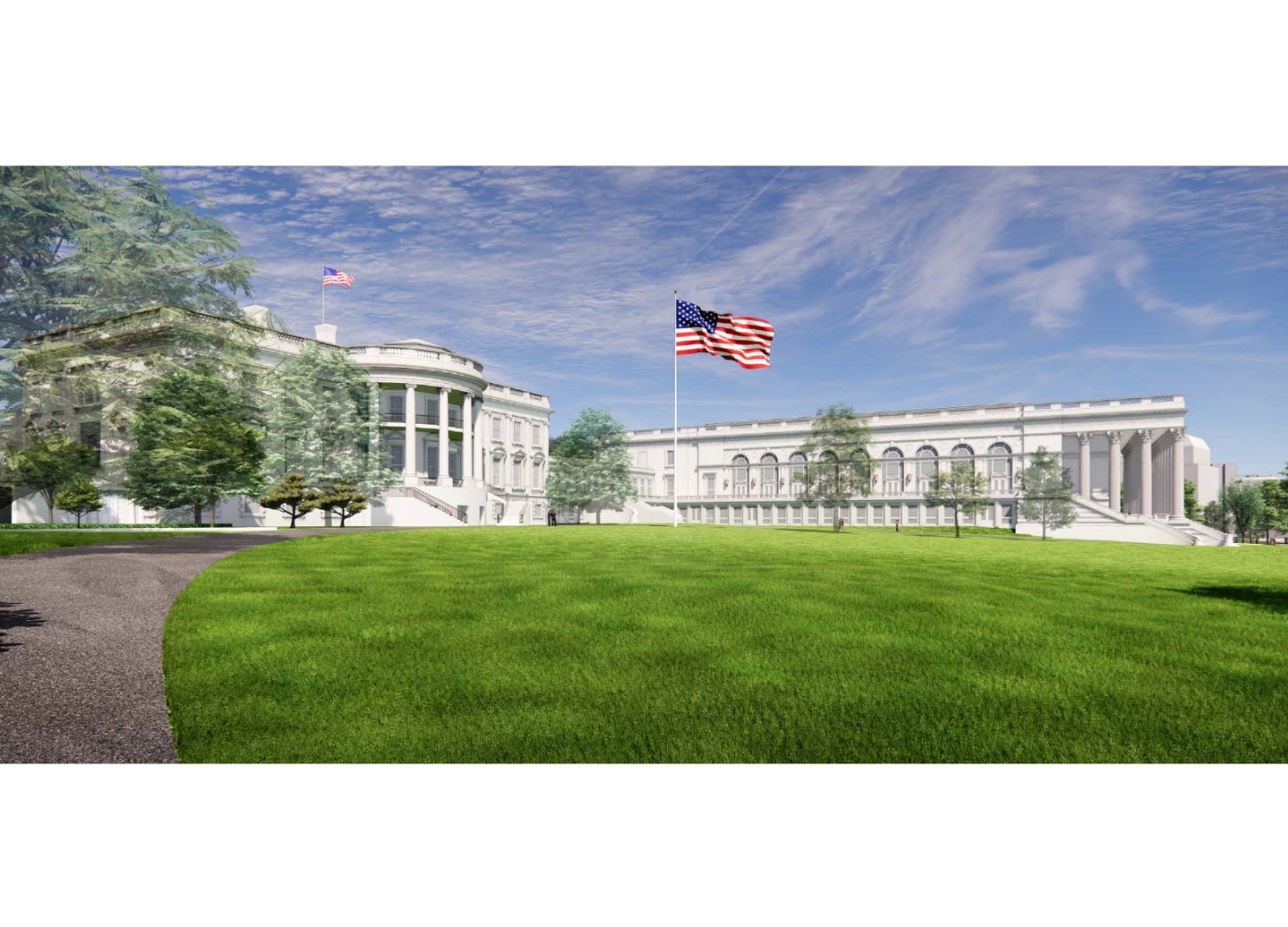
And like many experts and professionals in the architecture and design industry, she echoed similar concerns: The proposed $400 million, 90,000-square-foot East Wing addition that includes a 22,000-square-foot ballroom is “too much,” “too high,” costly and “ostentatious.”
Rowan also shared her feelings about the October demolition of the East Wing, although chairman of the commission, William Scharf, informed viewers of the meeting that the demolition was not part of the commission’s purview.
“I am grieving about the East Wing and how it was torn down. I visited as a child several times the White House, and once I did get to go past the East Wing. I won’t be able to show this to my grandkids when I take them to D.C. someday,” she said, urging the commission to listen to the overwhelming attitude of the public and experts that the current plan is “not in line with American values.”
From across the nation, more than 35,000 written comments were submitted and 104 people signed up to speak during the NCPC’s online public comment period. The commission is made up mostly of newly appointed members by the president prompting concerns that the comments from the public will be considered a formality and not taken seriously into the commission’s decision making.
Many people who signed up didn’t end up speaking, but left written comments as the portion of the meeting considering the East Wing extended beyond three hours. Ultimately, commissioners unanimously tabled discussion of the East Wing Modernization project to April 2, when a vote on the proposal is expected. The public comment portion at the close of Thursday’s meeting, though, has officially ended.
One supporter of the president’s proposal said the ballroom was greatly needed.
“I’m in full support of what our president is doing,” said Tara Brown, a distillery owner, “and we should be thankful and blessed to have had someone like President Trump, who’s had decades of building doing this project.”
Throughout the public testimony, experts raised many design concerns.
Among them were that the size and mass of the proposed ballroom diminishes the residence and cuts away at the intention of the initial design of the White House—that the president’s house should be the commanding, yet humble, presence of the complex and the West and East Wings should be subordinate and smaller.
Also at issue was how the size of the proposed East Wing introduces an imbalance between the structures with the ballroom dominating. Additionally, experts argued how the axis view on Pennsylvania Avenue from the White House to the Capitol—a foundational, intentional design by George Washington’s 1791 federal city commissioned designer Pierre Charles L’Enfant—would be forever obstructed by the ballroom. And, they raised issues with symmetry, a tenant of the White House’s classical design, as a result of the ballroom’s imbalance and how the structure would protrude into the South Lawn driveway creating a kink in its overall circular symmetry.

Other criticisms leveled included the design of the south portico of the proposed ballroom, which was modified from earlier versions by removing the pediment. Commenters took issue with the Corinthian columns on the portico because they appeared grander than the columns on the residence. The exterior stairs from the ballroom spilling out onto the lawn were also scrutinized for adding to the mass of the addition.
When asked if the south portico of the ballroom was essential to the design, the White House-hired architect Shalom Baranes said it was not.
“It’s really an aesthetic decision,” Baranes said.
Some public comments supported the idea of a ballroom, but on a smaller scale. Commissioner Phil Mendelson questioned the need for 22,000 square feet for the ballroom when a standard industry size is 15,000 square feet.
Baranes said the extra space was needed to accommodate cameras for journalists, honor guard and additional security space to allow for emergency evacuations.
In addressing Commissioner Mendelson’s question about the imbalance between the existing single-story West Wing colonnade and the proposed two-story East Wing colonnade, Baranes elaborated on the White House and its history of imbalance, specifically of the complex’s neighboring Treasury and Eisenhower Executive Office buildings that were built out larger than originally envisioned, he said.
“The question I would raise is, can it be viewed as another building on the campus, which joins a larger family of buildings and mediates the scale between Treasury to the White House?” Baranes asked. “Or, alternatively, is its proximity to the White House such that it can only be viewed as an addition with no other considerations?”
He went on saying there is a functional need today that did not exist historically that cannot be met by the existing facilities of the White House requiring “revisiting the whole question of context and scales and imbalance.”
For preservationists, though, the threat to the White House’s symbolic design was a grave line to cross.
Carol Quillen, president and CEO of the National Trust for Historic Preservation, remarked that a 1,000-person ballroom could be built—unlike the plan currently under review—that truly honors the iconic status, the primacy, and the historic significance of the People’s House.
“You don’t have to choose between respecting our history for the American people and accommodating modern government’s needs. In the case of the East Wing Modernization Project, you can do both,” she said. “Doing both, however, will require that you take your time, that you move deliberately, that you engage seriously with ideas offered by the tens of thousands of architects, planners, scholars, and patriotic citizens who have submitted comments. These people are worth hearing out. The American people have good ideas.”
Comments submitted, she added, show how the ballroom could be smaller and still hold 1,000 people for a seated dinner. Its height could be lowered and still accommodate the functions proposed in the current plan.
“This consultative process exists for a reason,” she said. “To borrow words U.S. Supreme Court Justice Gorsuch used to describe our legislative process, it enables you to tap the combined wisdom of many, and not just that of one man or faction.”


