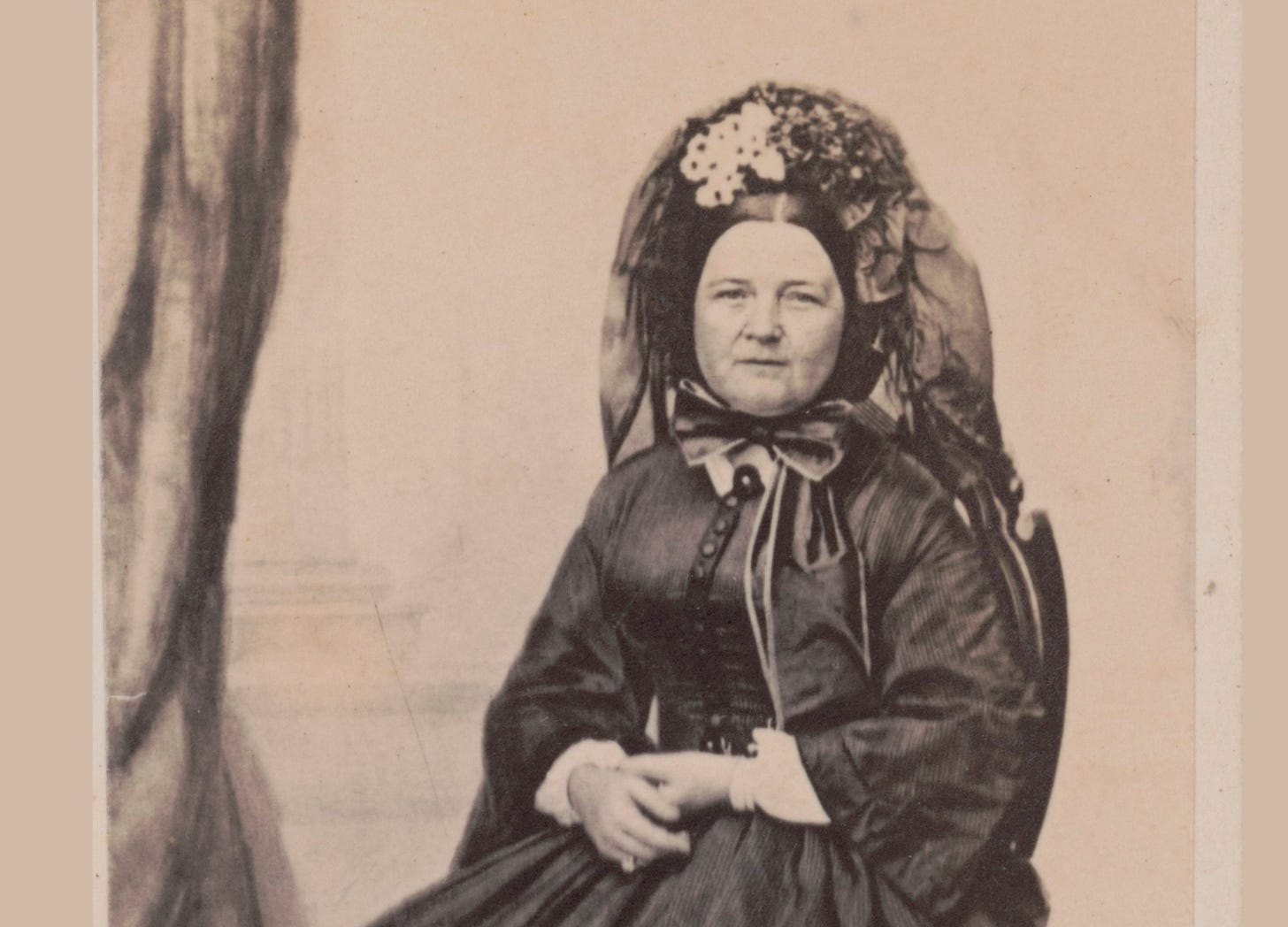
In Defense of Mary Lincoln
Author Lois Romano dismantles distorted narratives of the tragic first lady devised mostly by men.

Mary Lincoln is known as the wife of martyred President Abraham Lincoln, who was assassinated at her side inside Ford’s Theatre. Many historians would come to regard him as one of greatest American presidents for his leadership, political skills, accomplishments and character. The size of the Lincoln Memorial on the National Mall in Washington, D.C., and the number of people it attracts annually affirm that.
History, however, has not afforded Mrs. Lincoln the same consideration. Not even close. In fact, it has taken more than one attempt by female biographers to try to reshape the narrative around Mary Lincoln into one that is honest and fulsome.
Perhaps the closest reckoning yet comes in the recently published New York Times Bestseller An Inconvenient Widow: The Torment, Trial, and Triumph of Mary Todd Lincoln, in which author Lois Romano meticulously pinpoints where Mrs. Lincoln’s legacy was lost: at the hands of mostly men.
“I know I’m saying something different than what other people said,” Romano, just days after learning of her book’s bestselling status, tells East Wing Magazine in a Zoom interview about past scholarship on Mrs. Lincoln. “But I’m confident I’m right.”

A timeline of traumas
In what Romano describes as her “first serious book,” the tone is set before the story starts. A three-page timeline after the table of contents lays out a series of significant events in Mary Lincoln’s life. The second date, listed after Mary’s birth on December 13, 1818, is when her mother died in childbirth, leaving her motherless at age 6. As the years pass, so do Mary Lincoln’s ups and downs as she and her husband ascend in political life. Notably, her personal traumas also escalate.
Shortly after Lincoln’s time in Congress, over 1849 and 1850, Mary Lincoln lost her father in a cholera outbreak and her second son, Eddie, from tuberculosis.
“The emotional impact of the deaths of her father and son is devastating for Mary,” Romano writes.
About a month after Lincoln’s inauguration in 1861, Confederate forces fired on Fort Sumter in South Carolina, sparking the Civil War. Seven of Mary Lincoln’s half-brothers and her brothers-in-law align with or fight for the Confederacy, ultimately calling into question her loyalty to the Union.
Less than a year later in 1862, the Lincolns’ 11-year-old son, Willie, died in the White House of typhoid, leaving Mary Lincoln inconsolable. In 1863, Mrs. Lincoln was severely injured in a carriage accident that was rumored to be an assassination attempt on the president. And on April 14, 1865, President Lincoln was assassinated at Mary’s side in the Ford Theatre.
Mary Lincoln was 46 years old.

Her widowed life would become increasingly difficult. And while Romano describes Mary Lincoln herself as “difficult,” the burdens and wildly false characterizations of Mrs. Lincoln in the remaining years of her life and well into her legacy are now more closely scrutinized. With access to more digitized records, Romano traces how a history that reveres Abraham Lincoln could relegate Mary Lincoln to villainhood.
Her husband was horrifically assassinated, but Mrs. Lincoln also suffered a blow. In the years after President Lincoln’s death, Mrs. Lincoln suffered a cruel, nearly insufferable existence. Mrs. Lincoln’s legacy was plagued by negative narratives that only solidified over time. Much of it was made and shaped, as Romano documents, by men.
The men who harmed Mary Lincoln’s legacy
The research is clear. Mary Lincoln was a tough personality, Romano concludes from her five years writing the book.
“She was outspoken, she could be irascible, she could be imperious, and she rubbed people the wrong way,” Romano says.
That part of her “excitable” personality was documented early on with accounts from her years in Springfield, Illinois, where Mary and her future husband met while he worked as a prominent state legislator. Letters reveal, for example, times when neighbors would send their children to stay the night at Mary’s house to calm her during thunderstorms while her husband was away.
“She was an anxious woman,” Romano says, noting people in that small community saw past her personality and protected her. “They saw her goodness and generosity.”
But that protective cocoon disappeared, and the narrative around Mary changed once Mr. Lincoln was elected president and they occupied the White House. Mary Lincoln was from the South, the border state of Kentucky, and half of her family was aligned with the Confederacy, Romano explains.
“Immediately, the South hates Lincoln. Immediately, she gets branded a spy in the North,” Romano says. “The South thinks she’s a traitor. So this narrative takes hold that somehow she’s this enormously powerful woman running the government.”
It’s a narrative Romano traced through letters people were sending to each other, mostly men who were saying Mary Lincoln was “making and breaking the careers of men.”
“She just didn’t have that kind of power,” Romano says, but it did mark a beginning of unprecedented media coverage of a first lady. She was cast as a traitor who was slowing down Lincoln’s actions against slavery (she wasn’t). She was also said to be controlling political patronage (she wasn’t). “No other first lady had received this kind of scrutiny by the media,” Romano says.
Or even immediately after Mrs. Lincoln. It would be years before “yellow journalism,” a style of newspaper reporting emphasizing sensationalism over facts, reached its peak in the late 19th century.
Thousands of new digitized records scoured by Romano turned out to be particularly helpful in producing her better-rounded portrait of Mrs. Lincoln. They show how the actions of the men surrounding the late president indelibly harmed the widowed Mary Lincoln and her legacy. No other first lady has been as vilified as Mary Lincoln; meanwhile, her husband has reached near-mythological status. Even in the years directly following her husband’s murder, Mary Lincoln couldn’t understand why her stature wasn’t elevating along with his.
William Henry Herndon
William Henry Herndon, a law partner and biographer of Abraham Lincoln, made a damaging negative imprint on Mary Lincoln’s legacy, Romano says. Right after Lincoln’s death, Herndon put himself out there as an expert on the former president. He collected a lot of information on the former president and then traveled doing lectures about Lincoln.
“He becomes this magnet for people wanting to write about Lincoln,” Romano says. “This is a moment for Herndon. It was probably the most important thing that ever happened in his life—Lincoln’s death—because all of the sudden he’s being sought after, and people want to talk to him.”
Herndon and Mary Lincoln never got along, Romano says. She thought Herndon was beneath Lincoln and that he should have never been asked to be Lincoln’s law partner.
“Mary had a sixth sense about people, and she just didn’t like him and she refused to have him in her home,” Romano says.
It didn’t go unnoticed by Herndon. In letters cited by Romano, he expresses how Mrs. Lincoln only has an “aristocratic” guest list.
“It gnaws at him,” Romano says. And years later after the assassination, Herndon co-authors the book Herndon’s Lincoln: The True Story of a Great Life that paints a horrible picture of Mary Lincoln, a sort of revenge, she says. “Very little was written about first ladies. They usually went away back then, but he would not let people forget about Mary.”
Romano refers to one anecdote in his book where Herndon talks about the Lincolns hosting highfalutin parties and how Mary would scream at Lincoln all night about what he did wrong, and then Lincoln would leave the house after the party. “Well, Herndon wasn’t there,” Romano notes.
Even the Lincolns’ eldest son, Robert Todd Lincoln, denounces the book because of its unsubstantiated recounting of Ann Rutledge being Lincoln’s the only romantic love in his father’s life. And so a distorted narrative of Mary Lincoln took root as other biographers for decades recycled Herndon’s version.
“The legacy takes hold, and I blame it initially all on him,” Romano says. “He starts the negative narrative based on very, very little.”
David Davis
In the aftermath of the assassination, Robert Lincoln asked David Davis, a lifelong friend of the president’s whom Abraham Lincoln later appointed to the U.S. Supreme Court, to be the executor of his father’s estate. Romano describes in her book how Davis’s role would send Mary Lincoln down an unnecessarily difficult path in the immediate years after Lincoln’s death.
When Mary Lincoln left the White House, she did so with widely reported shopping debts. In her grief, she did not want to go back to the family home in Springfield, Illinois, where Davis had hoped she would return. Instead, she drifted from hotel to boarding houses, distressed that she couldn’t afford to buy her own home.
Not unexpectedly, Mary Lincoln believed wealthy benefactors would raise money for her, Republicans who benefited from Lincoln’s presidency would give her money, merchants would forgive her debts, and houses would be gifted to her, Romano writes.
“She was baffled that others did not see her as she saw herself, as an extension of the martyred president,” Romano writes, noting it did not go unnoticed by Mary Lincoln when the heroic General Ulysses S. Grant was gifted three mansions, in Washington, D.C., Philadelphia and Galena, Illinois.
It had been anticipated that Lincoln’s estate would be settled within a year, Romano writes. But Davis did not release the funds for two and a half years with no documented reason for the delay, except, Romano speculates, that perhaps Davis, aware of Mary Lincoln’s overspending patterns, thought he knew best how to invest it.
“He is the executor of the estate and he could have settled it, but he didn’t,” Romano says.
At one point, Davis said in a hearing that Lincoln left his family money and Mary Lincoln didn’t need to be paid his remaining full salary.
“Yet he wouldn’t settle the estate,” Romano says, adding that before the estate was settled, Robert Lincoln asked Davis for and was given $4,000. “But he refused to give Mary extra money when she needed it.”
During this time period, Romano writes, it would have been easy for the men around Abraham Lincoln to lessen his widow’s anxiety and financial worries. Davis was a prominent, wealthy, and powerful man who could have “given her more money from the estate or from his own pocket.”
In July 1865, Davis, in a visit with Mary Lincoln, infuriated her by telling her she would have to be content with boarding because no one would bestow her a house. She responded, Romano writes, that she would no longer board in Illinois.
“If we are to be vagrants,” writes Romano quoting Mary Lincoln in her book, “I prefer being so, in any other state rather than where every man in the State owes my husband a deep debt of gratitude.”
In the time that Davis controlled Lincoln’s estate, Romano writes, he grew it from $83,343 to $110,974 (exclusive of the real estate). Romano notes that an example of Davis’s wealth was when a few years after Lincoln’s estate was settled, the judge built a 36-room Italian-style villa over 1870-1872 in Bloomington–open for tours to this day–while Mary and Tad were living in a hotel.

“Davis thought by saying Mary didn’t need money, he was protecting Lincoln,” Romano says. “He didn’t want it to be like Lincoln left her destitute. So, he would tell everybody she has money, but he was really harming her because she didn’t have access to the money.”
It wouldn’t be until a desperate Mary Lincoln attempted to sell some of her clothing in New York that scandal erupted. Romano writes that more than 2,000 newspaper stories about the “old clothing sale” described the widow as “vulgar,” “revolting” and, in one Illinois newspaper, “insane.” The mostly negative publicity embarrassed Robert Lincoln and led Davis to finally settle the estate 31 months after Abraham Lincoln’s death.
Yet, according to one Chicago newspaper’s story, it was reported that Robert Lincoln tried to explain away his mother’s behavior after the botched clothing sale. In it, Romano writes, a newspaper article reported that Robert Lincoln regarded his mother’s conduct as a “deep mystery” and “the only theory he can suggest in her defense is that she is insane.”
The lawmakers fighting against Mrs. Lincoln
In late 1868, Congress took up the discussion of a possible $5,000 pension for Mary Lincoln in what initially seemed like good news for the widow, who had been living quietly in Germany at the time. The proposed legislation, though, thrust Mary Lincoln back into the national spotlight. Richard Yates of Illinois told Congress that Mary Lincoln betrayed her husband and was a traitor. But, Romano writes, he didn’t show up for the vote. Another Republican senator, George Edmonds of Vermont, wanted Mary Lincoln investigated to see if she was destitute or affluent. It caused the debate about a pension to drag on, beginning “a familiar odyssey of powerful men arguing publicly about Mary’s future,” writes Romano.
“They were finding ways to harm her,” she says.
By July 14, 1870, more than five years after the assassination, the Senate approved a $3,000 pension for Mary Lincoln.
Robert Todd Lincoln
With the Lincoln estate settled and a pension secured, Mary Lincoln’s troubles seemed to be behind her. But upon the former first lady’s return to America with her then-18-year-old son, Tad, the next wave of suffering came crashing down. Tad Lincoln became ill on the return voyage and on July 15, 1871, he died of an undetermined lung infection.
The loss was devastating for Mary Lincoln and her last surviving son, Robert. Consequently, what unfolded four years after Tad’s death was particularly tragic. Mary Lincoln’s insurmountable grief, the use of likely addictive prescribed medications to address chronic migraine pain, and perceived erratic behavior led Robert Lincoln to orchestrate a surprise “insanity trial” that assessed her mental state with opinions from 17 witnesses, including several doctors. Only one doctor treated her and only one examined his mother. She was declared insane.
Romano points out Mary Lincoln’s one legal protection was a newly enacted Illinois law, which required a jury trial before anyone could be confined to an asylum. The 1867 Act for the Protection of Personal Liberty, or “Packard’s Law,” was named for Elizabeth Packard, whose husband, a Calvinist minister, forced her confinement in 1860 to the Illinois State Hospital for the Insane because she “angered him by disagreeing with his religious beliefs,” Romano writes.
While the law was a marker for women’s rights, it did not change the hold patriarchal culture had on society, and it didn’t keep Mary Lincoln from the jury’s swift decision—made in 10 minutes—that she was a “fit person to be institutionalized.”
“Mary’s three-hour trial had all the stereotypical overtones of the era: the misogynistic view of women as the weaker, more hysterical, and less intelligent sex, coupled with a lack of knowledge about mental health,” Romano writes.
Mary Lincoln didn’t give up. She was confined at Bellevue Place Sanitarium in Batavia, Illinois, for three months in 1875 before she was released to her sister, Elizabeth Edwards, in Springfield as a result of the guidance of prominent Chicago lawyers James and Myra Bradwell.

“It’s because of [Packard] that Mary Lincoln had to go to a trial at all to put some boundaries between folks who would abuse familial power,” says Kate Garrett, director of the Batavia Historical Society. Bellevue Place still exists today in the form of a condominium building and as a historical landmark because of Mrs. Lincoln’s stay. Garrett notes that Bellevue is interesting because it was a private institution.
“Those rooms were not inexpensive, the care was not cheap and affordable. This is definitely a family who can afford private nursing, private care,” Garrett says. “That does not mean that women here were content, necessarily, or happy, like the advertising that we have from Bellevue showing the sort of idealized hammocks in the yard, and women lounging in the library and taking strolls around the grounds.”
Nevertheless, Garrett notes, compared to other kinds of institutions, this one was “quite posh.”
About a year later and after a less publicized court hearing, Mary Lincoln would be deemed recovered and also reclaim control of her money from her eldest son.
“Robert damaged her legacy by labeling her insane in the courts. That was the lasting legacy and that’s where the ‘crazy’ comes from,” Romano says. “The irascible, the temper, the bad personality comes from Herndon.”
Re-remembering Mary Lincoln
Herndon, Davis and Robert Lincoln, Romano asserts, are most responsible for the personal harm done to Mrs. Lincoln as well as her legacy.
But there were others, too, who thought they could exert their control over her life circumstances. For instance, Romano tells the story of Abraham Lincoln’s “gravesite battle” that involved Springfield civic leaders who wanted the president’s tomb to be located in their downtown. They acquired the land and began preparing it as Lincoln’s final resting site, but without consulting Mary Lincoln. When she got wind of their plans, she fought them and prevailed. Lincoln was entombed in Oak Ridge Cemetery, a quieter place, outside of Springfield—a place of Mrs. Lincoln’s choosing.
Lincoln’s allies didn’t understand that by stepping up to help Mary Lincoln they would protect Abraham Lincoln’s legacy, too, according to Romano. Many of these men, she agrees, were opportunists in the wake of Abraham Lincoln’s assassination and during his rise to martyrdom.
“They were all embracing [Lincoln’s] coattails,” Romano says. “I think they just wanted her to go away. That’s where the title of the book comes from. She was just an inconvenience.”
It’s also important to consider Mrs. Lincoln, though, through the lens of that time period, according to Elizabeth Thacker-Estrada, president of the Institute for Historical Study. Even though Mrs. Lincoln was a prominent woman, coverture—a construct based in English common law where the husband and wife are one—lingered in society. And “actually the ‘one’ is the husband,” she notes.
“When married women have no right to own property, no right to make contracts, even a well-known woman didn’t really have that many legal rights,” Thacker-Estrada says.
Other contributing factors to Mary Lincoln’s struggles early on, adds Thacker-Estrada, could have been the plethora of Civil War widows. She notes that settlements were protracted because of slower court systems, limited legal infrastructure and less-standardized procedures.
“That all makes sense, and many states had local probate courts with backlogs, limited staff, and no statewide uniform probate codes,” she says.
The ideology of “the Cult of Domesticity” or “the Cult of True Womanhood,” which applied primarily to middle- and upper-class white women in the mid-19th century, confined women to a narrow domestic sphere and dictated the ideal roles she should play, Thacker-Estrada adds.
“Mary Lincoln, with her strong-willed personality, ambition, and outspoken political opinions, sometimes crossed the threshold of what people of her era considered ladylike, submissive, and ideal womanhood,” she says.
However, Mary Lincoln’s legacy, as Romano shows, is ripe for reassessment through a modern lens.
“I’m very impressed by her resilience,” Thacker-Estrada says of Mrs. Lincoln. “Even though she was prostrate with grief after the assassination, she roused herself enough to ensure that Abraham Lincoln was buried where Lincoln wanted to be buried. … There’s a stereotype about Southern women: the velvet glove over the iron fist. These women were stronger than often given credit for.”
As Romano continues to make the rounds on her book tour, she pauses and considers what her biography means for the future of Mary Lincoln’s story. She hopes her book contributes to turning around Mary Lincoln’s narrative and helps to correct lies that were told. She hopes it puts into context the limited ability to treat mental illnesses for both men and women and recognize the side effects of sedatives prescribed at the time. And she hopes people begin to focus more on the positive contributions of Mrs. Lincoln as first lady and a female figure fighting for herself as the American suffrage movement was taking hold.
Mary Lincoln, for certain, did a service to future first ladies, Romano writes. She was the first sitting first lady of an assassinated president. Her trials and tribulations paved the way for the more sensitive treatment of future widowed first ladies and set a precedent for pensions. Within a few years after Mary Lincoln’s ordeal, widowed First Ladies Lucretia Garfield, Sarah Polk and Julia Tyler would all receive pensions.
And Romano hopes if her book is the first or last thing people read about Mary Lincoln, then perhaps that will be what they tell their children.