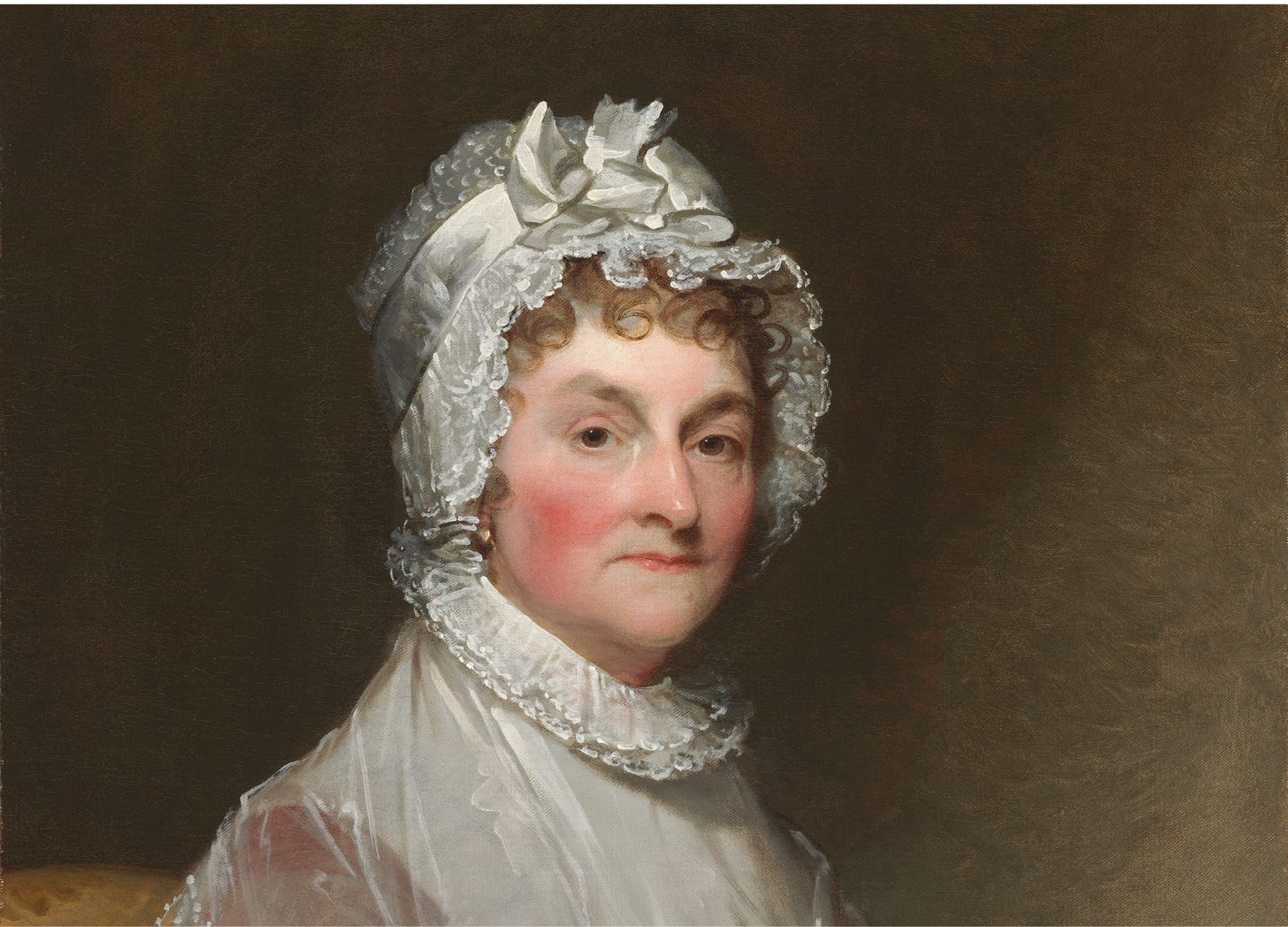
Humanizing the Heroism of Abigail Adams
Book review by Stephanie K. Bohnak
As Americans commemorate America 250 from coast to coast, many have experienced a renewed interest in first ladies’ history. While a selection of visitors and program attendees of the National First Ladies Library & Museum ask about the first First Lady, Martha Washington, countless others are engaged in the stories of First Lady Abigail Adams. Now when we think about the legacy of Adams, most people first recall her famous ‘remember the ladies’ quote, which she penned in a letter to her husband, the future second president of the United States, John Adams. After this first impression, others who are aware of First Lady Adams may also remember that she famously melted down her own silverware to make bullets for the Continental Army during the American Revolutionary War or that she was among the first in her local community to be inoculated against smallpox.
What many don’t realize or remember is Abigail Smith Adams was deeply human, a woman in an era that had no legal protections for herself, and a mother, who like many during her time worried for her children’s safety, and mourned those she had lost. A Founding Mother: A Novel of Abigail Adams by Stephanie Dray and Laura Kamoie blends these recollections to present a full picture of our second first lady of the United States, and in doing so, underscores the humanity of the Revolutionary Era as we hold this period in remembrance in 2026.
Historical fiction often walks a fine line in the world of academia and within the public history sector. Because it is often accessible and entertaining, this genre of literature has immense pressure placed on it as many historians still shy away from utilizing these works. In the past, historical fiction prioritized entertainment, excitement, and even scandal rather than historic accuracy, yet A Founding Mother challenges this paradigm. Compelling at its core and driven by primary research, the evolution of historical fiction throughout the last decade, is clearly exemplified in novels such as this. Bolstered by letters penned by the woman herself, it demonstrates a clear shift from fabrication to historical integrity. Thus, A Founding Mother: A Novel of Abigail Adams uses existing scholarship and primary sources to directly confront the reader with an especially unique women: one who challenged the social norms of her current society, scrimped to save money, used her social networks to expand her influence, and even one who pined for her loved ones as her husband and children crossed the Atlantic Ocean to Europe.
When we reflect on this era in American history, it’s somewhat easy to glorify this time as one in which everyone living under colonial rule sought freedom. Most common motifs envision everyone joined together, fighting for representation over taxation, and freedom from ‘tyranny.’ Yet, rather than fall into this trope, both Dray and Kamoie highlight the very real tensions of the time, including clashes between loyalists and patriots, the radical behavior of ‘rebels,’ and even the disconnect between women thinkers such as Mrs. Adams and her esteemed acquaintances like Mercy Otis Warren. A Founding Mother aptly illuminates the complexity of this period, while pulling into focus what many average individuals like Abigail Adams may have been thinking, feeling, and experiencing.
The full scope of the text itself is one of the novel’s greatest strengths. Without being unnecessarily verbose, the novel navigates the life of Mrs. Adams before, during, and after the Revolutionary War and her service as first lady, with sincere focus on the human and lived experiences that she endured outside of the patriot cause. These intentions to humanize the era and the woman herself are so craftfully interwoven, that when these human losses occur, it almost stops the reader in their tracks. The second chapter alone caused me to take my own pause as I sat there in silence following the remembrance of Susanna Adams. Whether she truly stated or thought the things listed in the book will be forever unknown, but when “Mrs. Adams” closed this chapter by stating that, “It was the wrong order of things, to outlive a child. But as our house went quiet and still with mourning, the soldiers continued marching outside–muskets at the ready. And that was unnatural too,” I was spellbound at the reflection that every parent who has lost a child must think and feel this, too. How beautifully human and tragic is it that even this amazing, resilient, and driven woman can be brought to her knees the way that all of us can be, regardless of the era in which we live.
“How beautifully human and tragic is it that even this amazing, resilient, and driven woman can be brought to her knees the way that all of us can be, regardless of the era in which we live.”
—Stephanie K. Bohnak
Even more impressive is the novel’s ability to immerse readers into the uncertainty of the Revolutionary Era. It’s easy for many to look back on the American Revolution as an inevitable triumph, remembered through images of patriotism, unity, and the pursuit of liberty. Dray and Kamoie resist this simplified narrative by presenting the strains of this era as it was experienced by those living through it: frightening, unpredictable, and deeply personal. From the aftermath of the Boston Massacre to the mounting tensions that divided loyalists and patriots, A Founding Mother encapsulates the fear, anger, and sacrifice that accompanied the American experiment. And in doing so, this novel reminds readers that victory wasn’t guaranteed. As Americans continue to navigate political division today, this novel demonstrates that political discourse and disagreement have long been part of this nation’s history. From Abigail Adams’ perspective, these imposing historical events become intensely human, revealing the resilience not only required to support a revolution, but to also maintain family and home under extraordinary conditions.
Another highlight is the novel’s structure itself. Divided into four distinct parts, A Founding Mother echoes the passage of time while also tracing Mrs. Adams personal growth, independence, and evolution alongside the fledgling nation’s own evolution. Each section introduces increasingly complex political and social questions without ever losing sight of the women at the heart of this story. Part One neatly establishes family life for the Adams family and the onset of the American Revolution, while Part Two broadens the narrative to explore the contradictions and promises of this new nation. Particularly interesting is the thoughtful inclusion and depiction of American enslavement and indigenous peoples throughout Part Three. Mrs. Adams’ well-informed opposition to the institution and her interactions with her formerly enslaved household member, Phoebe, as well as her interactions with Thomas Jefferson naturally introduce readers to the experiences of James and Sally Hemings during their time in Europe.
In the same vein, the appearance of indigenous tribes like the Creek and Cherokee throughout the last third of the book is refreshingly accurate and well-tempered. Real figures such as Alexander McGillivray were a welcome element to the unique history and relationship between the early American republic and those who were ultimately pushed from their homelands as it expanded. Rather than treat these stories as modern additions to satisfy contemporary expectations, Dray and Kamoie weave them into the narrative in which they historically belong. What results is an even richer and honest portrayal of the founding generation, one that embraced the complexities of their era rather than retreating into patriotic glorification. In a period where federal power and personal freedom seem to go hand in hand, A Founding Mother definitively embraces historical accuracy rather than apologetic entertainment.
“In a period where federal power and personal freedom seem to go hand in hand, ‘A Founding Mother’ definitively embraces historical accuracy rather than apologetic entertainment.”
—Stephanie K. Bohnak
On several occasions, I found myself reluctant to put this novel down, eager to explore the Adams family with each new chapter. Few works of historical fiction successfully balance meticulous research with compelling storytelling, yet A Founding Mother accomplishes this remarkably. Rather than overwhelm readers with endless names, dates, and political events, Dray and Kamoie immerse them in the lived experience of the Revolutionary and Founding Era through vivid sensory details, well-developed settings, and conversations rooted in surviving primary sources. Although the novel spans more than five decades of American history, it rarely loses momentum, carrying readers through Mrs. Adams’ early marriage years across the triumphs and tragedies of the early republic before skillfully returning to the War of 1812, where the novel first began. In doing so, the closing chapters created a sense of completion, allowing readers to reflect on how profoundly Abigail Adams and her family changed alongside this nation in a single lifetime.
If there is one place where the novel’s expansive scope occasionally works against itself, is in several secondary relationships. The breadth of the narrative is one of its finest elements, yet the necessity of moving quickly throughout decades of history leaves little room to fully explore figures who deserve more nuance. I found myself wishing for a more layered portrayal of Louisa Catherine Adams, whose relationship with her formidable mother-in-law has too often been interpreted primarily through tension and misunderstanding. Although the novel still acknowledges her intelligence and perseverance, later going on to be America’s first foreign-born first lady and one who endured hardship across Europe, her characterization occasionally echoes long-standing interpretations of tension between the two women. I would personally love to see a fuller exploration of these complexities that we as historians continue to uncover and debate. Yet, this speaks more to the ambition of the text rather than identifying a major shortcoming within its pages. Covering such an expansive time requires difficult editorial choice yet does not diminish the true humanity of Abigail Adams’ life.
Ultimately, the greatest achievement of A Founding Mother: A Novel of Abigail Adams is not only that it reconstructs Mrs. Adams’ life with remarkable adherence to historical accuracy, but that it also captures the philosophy by which she lived. Across each page, our second first lady emerges as a woman led by an unwavering dedication to family, her country, and her principles, even when they came at great personal cost. Her heroism is never portrayed as extraordinary but as quiet perseverance that defied social expectations of her time, and defined years of sacrifice, uncertainty, and loss. As both a public historian and a frequent reader of historical fiction, I found A Founding Mother to be an exceptional example of the genre I’ve encountered in recent years.
As we commemorate our nation’s founding 250 years ago, A Founding Mother reminds us that revolutions are not always made possible by declarations and on battlefields, but through the everyday women who sustained their homes, communities, and ideals in a fledgling nation. Although she has been long remembered for her ‘remember the ladies’ assertation, Dray and Kamoie challenge us to remember Abigail Smith Adams’ intellect, resilience, compassion, and enduring humanity. The year 2026 provides a unique invitation to explore and revisit our nation’s founding, not just seen in myths and monuments, but in the lived experiences of remarkable humans whose struggles and beliefs still resonate almost three hundred years later.

The National First Ladies Library & Museum at the First Ladies National Historic Site in Canton, Ohio, will discuss “A Founding Mother: A Novel of Abigail Adams” by Stephanie Dray and Laura Kamoie for its virtual First Ladies on the Page Book Club from 7 to 8 p.m. on August 26, 2026. The free event will explore Abigail Adams’ life as a wife, mother, political confidante, and one of the most influential women of the Revolutionary era.


