How I Discovered the Real Eleanor Roosevelt Through Her Photographs at Val-Kill
Guest Column by Holley Snaith

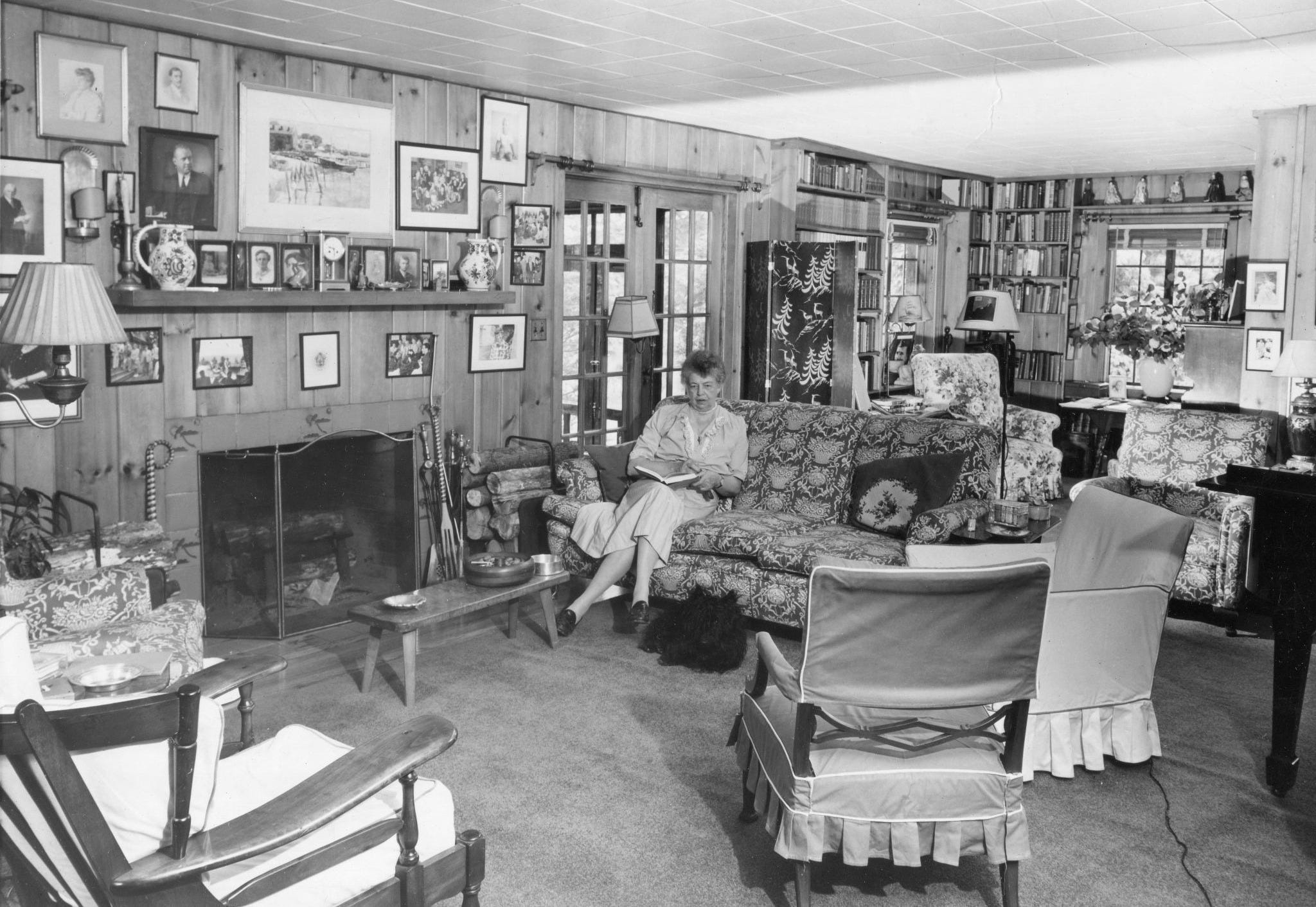
A fresh blanket of snow covered the grounds of Val-Kill, Eleanor Roosevelt’s retreat in Hyde Park, New York. The site was closed to visitors for the winter, and the only sounds were the wind moving through the bare trees and the occasional creak of the old house. Alone inside the cottage, I carried a large brown binder filled with black-and-white photographs from room to room, comparing images taken shortly after Eleanor’s death in 1962 with the walls around me. Those images offered clues to the people and memories the longest serving former first lady and activist chose to surround herself with during the final years of her life.
At the time, I was at the beginning of my career as a historian, yet the Roosevelts had already been part of my life for several years. I started researching Franklin and Eleanor Roosevelt at the age of 16, interned at Franklin D. Roosevelt’s Little White House in Warm Springs, Georgia at 17, and then, three years later, I worked in both the archives and museum at the Franklin D. Roosevelt Presidential Library. The National Park Service, aware of my interest in preserving the Roosevelt legacy, asked me to help restore the photographs that once hung on the walls throughout Val-Kill. I immediately said yes.
What I did not realize was that this project would be unlike any research I had undertaken before. Restoration requires historians to reconstruct a moment in time using pieces that have survived the decades. Some photographs were in their original locations, while others had vanished. Many had been scattered among family members, archives, collections, and even total strangers. My task was to identify them, locate them when possible, and return them to the places where Eleanor had chosen to display them.
When I began the project, I thought I knew Eleanor fairly well. Yet that was not the Eleanor I came to know through this project. What surprised me most was not who appeared on her walls, but what their presence revealed. The photographs uncovered a woman deeply devoted to family, fiercely loyal to friends, and profoundly shaped by the relationships that defined her life.
The walls of Val-Kill were arranged not to showcase accomplishments—but to preserve memories. In restoring them, I discovered an Eleanor Roosevelt who felt more human, more personal, and more complex than the historical icon I thought I already knew.
Why Val-Kill mattered
Val-Kill was Eleanor’s sanctuary and, in many ways, the one place she truly considered her own. Established in 1924 by her husband Franklin D. Roosevelt for Eleanor and two of her close friends, Marion Dickerman and Nancy Cook, the property became a refuge from the conventions that often accompanied her public life. While Springwood, the Roosevelt family’s estate in Hyde Park, was associated with Franklin Roosevelt and his mother, Sara Delano Roosevelt, Eleanor viewed Val-Kill as home. More than any other place, it reflected the life she built for herself, independent of both the White House and Springwood.
During Franklin Roosevelt’s ‘s lifetime, Eleanor had one standing rule: if he was in Hyde Park, whether as governor or president, she would stay with him at Springwood. When he was away in Albany or Washington, however, Val-Kill was where she preferred to be.


The cottage Eleanor eventually made her home began as Val-Kill Industries, a furniture-making enterprise founded by her, Marion, and Nancy to provide employment for Hudson Valley craftspeople. Although the business closed during the Great Depression, furniture made at Val-Kill remained throughout the cottage and in several other Roosevelt homes. The Stone Cottage, the first building visitors see when entering the property, initially served as the home of the three friends.
Over time, the living arrangements at Val-Kill evolved. Marion and Nancy eventually left the property, and after Franklin Roosevelt’s death in 1945, Eleanor made the Val-Kill Cottage her permanent residence. The Stone Cottage became home to her youngest son, John Aspinwall Roosevelt, his wife Anne, and their four children. For the remainder of her life, Val-Kill remained the place where Eleanor’s personal and public worlds came together. Family and friends gathered alongside distinguished visitors ranging from the Queen Mother and John F. Kennedy to neighbors and visitors from all walks of life.
After his mother’s death in 1962, John Roosevelt remained on the property for several years. Following his remarriage, he and his second wife decided to leave Hyde Park and settle permanently in New York City. Before doing so, they made the controversial decision to auction off many of his and Eleanor’s personal belongings. The sale upset many members of the Roosevelt family, several of whom attended the auction to purchase items that had belonged to their grandmother.
John sold the property to a group of New York physicians, and for years, Val-Kill’s future remained uncertain. Proposals for commercial development alarmed local residents, who organized preservation efforts that ultimately led to the creation of the Eleanor Roosevelt National Historic Site in 1977. Seven years later, in 1984, the nonprofit Eleanor Roosevelt Center entered into an agreement with the National Park Service to ensure the property’s preservation and public accessibility.
In the years following Eleanor’s death, and after the auction, many of the personal items that had filled Val-Kill, including her personal photographs, became scattered. Some found their way into the archives of the FDR Presidential Library, others were stored in National Park Service collections nearby, a number were returned to family members, while the whereabouts of others remained a mystery.
When Val-Kill opened to the public in 1984, the National Park Service did the best it could with the materials they had available. Photographs of Roosevelt family members and friends were displayed throughout the house, but historical accuracy and original placement were not the primary goals. Yet where Eleanor chose to display a photograph was itself part of the story. A portrait beside her bed carried a different significance than one hanging in a hallway. It was clear that reconstructing what had actually hung on the walls during Eleanor’s lifetime would require a different approach. More than 30 years later, that was where I came in.
Piecing Together Eleanor’s World
At the beginning, the research was a challenge because all I had was the heavy brown binder filled with black-and-white photographs of Val-Kill taken by an archivist named William Stickle from the FDR Presidential Library. He had gone to Val-Kill shortly after Eleanor’s death in November 1962 to photograph the cottage.
In a small corner office at the nearby Vanderbilt Mansion National Historic Site, I spent weeks bent over that binder with a magnifying glass, studying each image and trying to identify the pictures hanging on the walls. It was painstaking work, and it felt like solving a puzzle just one piece at a time. I was delighted when our curator, Frank Futral, located digital copies of the archival photographs for me to study on a computer, allowing me to zoom in and out and examine details that had been nearly impossible to see before, and compare images side by side.
I would then return with the binder to Val-Kill and compare the photographs hanging on the walls in 1962 to what visitors were seeing now. Some photographs remained in their proper places, while others had disappeared over the years, and it was my job to find them. Because I was already familiar with so many members of the Roosevelt, Hall, and Delano families, as well as Eleanor’s closest friends and associates, identifying the subjects in many of the missing photographs was often the easy part. The real challenge was tracking them down.
The next step took me into the archives of the FDR Presidential Library, where carts filled with photographs from Val-Kill were rolled out for me to examine and compare with the Stickle Photos. Some of the missing images were located there, while others still needed to be found. From there, the search continued at a National Park Service warehouse in Hyde Park, where I repeated the same process, sifting through photographs and records in hopes of finding more matches.
At the same time, I began reaching out to members of the Roosevelt family and longtime family friends. Some were able to identify photographs that had confounded me, while others provided leads on how to obtain copies of images that neither the FDR Presidential Library nor the National Park Service possessed. What began as an archival project soon became a collaborative effort involving me, archivists, park staff, family members, and friends, all working toward the same goal.
Yet the research itself was only part of the experience. Being at Val-Kill when it was closed for the winter was almost magical. There were no visitors, no tour groups, and no noise. In those moments, it was easy to imagine Eleanor sitting in her office answering her mail, sometimes well past midnight, or the Roosevelt grandchildren bursting through the door after a summer swim. I could picture the famous Christmas closet upstairs overflowing with gifts. It was then that I realized this project was really about restoring a moment in time—not simply returning photographs to walls. Restoring the photographs meant restoring the story Eleanor wanted visitors to encounter when they walked through her home.
It was then that I realized this project was really about restoring a moment in time—not simply returning photographs to walls.
—Holley Snaith
I thought about the visitors who would walk through Val-Kill’s doors in the years ahead, many of whom might know very little about Eleanor. Perhaps one of them would stop and notice a photograph of a woman holding a tennis racket hanging in the living room and wonder who she was. That would lead them to discover that the woman was Martha Gellhorn, the celebrated war correspondent and journalist, as well as the one-time wife of Ernest Hemingway. Hers was just one of many fascinating stories represented by the images that Eleanor surrounded herself with.

What the photographs revealed
As the restoration progressed, I began to see Eleanor’s home as she had intended it to be seen. The photographs reflected not a collection of accomplishments, but a life shaped by family, friendship, and memory.
Perhaps nowhere was that more evident than in the presence of photographs of her husband throughout the cottage. So much has been written about their relationship, much of it incorrect or sensationalized, yet one thing became clear through the images: even years after Franklin Roosevelt’s death—despite all that had passed—his memory remained deeply important to Eleanor. Not only as a husband, but also as a leader she genuinely admired. Portraits of him occupied a prominent place throughout Val-Kill. For example, each morning when Eleanor awoke, one of the first things she saw was the large portrait painted by artist Frank O. Salisbury. The portrait, a copy personally inscribed and presented to Eleanor by Salisbury, was the former president’s favorite likeness of himself and later became his official White House portrait.

Family occupied an equally important place, and several members of the Roosevelt family proved invaluable to the project. Elliott “Tony” Roosevelt, Jr., one of Eleanor’s grandsons, and his wife, JoAnne, generously shared copies of wedding photographs that had hung in Eleanor’s bedroom. His sister, Chandler Roosevelt Lindsley, did the same, and she and I enjoyed several conversations throughout the process.
One of my favorite conversations was with Eleanor “Ellie” Seagraves, the eldest Roosevelt grandchild and the daughter of Anna Roosevelt. Ellie and her brother Curtis, known to the public as “Sistie” and “Buzz,” spent much of their childhood at the White House with their grandparents. Ellie fondly remembered her grandmother’s beloved horse, Dot, which she often rode around Washington. She also recalled a special playground Eleanor had created for the grandchildren on the White House grounds. According to Ellie, both her mother and grandmother grew increasingly frustrated when curious passersby would stop to watch the children play as though they were part of an exhibit. Eventually, additional shrubbery was planted to provide them with more privacy.

Through her grandchildren, I discovered Eleanor the grandmother, a woman whose greatest joy often came not from politics or world affairs, but from her family.
Among the most moving objects in Eleanor’s bedroom was a small watercolor portrait by Sonia Routchine of the first Franklin D. Roosevelt, Jr., who died from influenza in 1909 before he was eight months old. Nearby were two versions of the same photograph showing the baby with his nurse at the Roosevelt family’s home on Campobello Island. In 1914, the Roosevelts welcomed another son and gave him the same name, Franklin D. Roosevelt, Jr. He would live until 1988, but the presence of these keepsakes shows that Eleanor never forgot the child she lost.
Yet her world extended far beyond Hyde Park. Throughout the house were reminders that she was not only a beloved mother and grandmother, but one of the most respected women in the world. Inscribed photographs bearing thoughtful messages from figures such as French President Vincent Auriol and Canadian Prime Minister William Lyon Mackenzie King showcase the extraordinary circles in which she moved.
If family formed the center of Eleanor’s world, friendship was another pillar of it. The walls of Val-Kill featured photographs of many of the women who shaped her life. There were images of her mother, Anna Hall Roosevelt, who died when Eleanor was just 8 years old, as well as her mother-in-law, Sara Delano Roosevelt, and other relatives. Alongside them were photographs of aviation pioneer Amelia Earhart, her beloved Allenswood headmistress Marie Souvestre, pioneering journalist Lorena Hickok, and her longtime friend Isabella Greenway, the first woman elected to Congress from Arizona.
One of the most touching photographs in the office was that of Malvina “Tommy” Thompson. Tommy served as Eleanor’s secretary for three decades, but she was far more than an employee. She became part of the Roosevelt family and was deeply loved by Eleanor’s children and grandchildren. When Tommy died in 1953, Eleanor was devastated. Tommy’s photograph in what was once her wing of the cottage reflects her importance in helping sustain Eleanor’s demanding public life for decades.

I was particularly pleased to discover a photograph in Eleanor’s bedroom of Marguerite “Missy” LeHand, Franklin Roosevelt’s secretary for more than 20 years. The photograph was especially meaningful because I was simultaneously assisting author Kathryn Smith with research for The Gatekeeper, her enlightening biography of Missy LeHand. Photographs of Missy and Tommy speak volumes about the affection and loyalty that existed between the Roosevelts and those in their inner circle, revealing that they were viewed as members of the family.
More than the first lady of the world
By the time the project was nearing completion, I had spent countless hours studying the people and places Eleanor chose to surround herself with. In doing so, I began to understand her in a way that wasn’t possible from years of reading books and archival documents.
Despite the barriers she broke and the achievements that made her one of the most influential women of the 20th century, Eleanor was more traditional than I had expected. That impression was reinforced not only by the photographs she chose to display, but also by the conversations I had with her grandchildren.
Reminders of Eleanor’s public life were certainly present. Photographs of close friends and activists such as Joe and Trude Lash reflected her commitment to the causes she championed, while images connected to organizations such as the International Student Service showed her enduring interest in young people and international events. During World War II, the organization worked to assist students whose lives and educations had been disrupted by war and the rise of fascism, a cause Eleanor strongly supported. Even so, those aspects of her life did not dominate the walls of Val-Kill.
Instead, places of honor were reserved for family and personal memories. Wedding photographs, portraits of grandchildren, images of Franklin Roosvelt, and treasured keepsakes appeared again and again throughout the cottage.
In the end, I realized Eleanor was not as different from the rest of us as I had once imagined. The woman who influenced global conversations and traveled the world also cherished family traditions and chose to surround herself with reminders of the people she loved.
The collection revealed a woman who was both extraordinary and deeply human. More than anything else, they showed that what mattered most to Eleanor was not power, prestige, or public acclaim. It was the people who shaped her life.

Restoring memories, not just photographs
Over the course of nearly a year and a half, the curatorial team and I worked to bring this project to life. Identifying the missing photographs was only the beginning. Once they were located, copies had to be made, frames ordered, and the images returned to their proper places throughout the house. At the same time, I researched and wrote captions for both the existing and newly restored photographs, many of which can now be found on the National Park Service’s Eleanor’s Pictures website.
In the end, I realized we were not simply restoring photographs to walls. We were restoring the memories Eleanor chose to preserve.
Naturally, there were a few photographs we could not identify or return to their original locations. Perhaps someday they will be. That is the beauty of historic preservation. It is never truly finished. Each generation brings new questions, new discoveries, and new ways of understanding the past. There are still mysteries surrounding some of the photographs that hang on the walls today. Who is this person? What is the story behind this image? For now, some questions remain unanswered.
This project will always remain one of the highlights of my career. Knowing that my work, along with the efforts of superb colleagues, will continue to be seen by visitors for years to come is deeply gratifying. More importantly, the experience only deepened my respect for Eleanor.
As the United States celebrates its 250th anniversary, historic sites dedicated to first ladies and other influential women may be an afterthought for some. Yet preserving these places and sharing their stories remains essential. They remind us that history is shaped not only by presidents and political movements—but also by relationships, families, friendships, and the lives people build behind the scenes.
When visitors walk through Val-Kill today, they encounter more than Eleanor’s home. Through the photographs lining its walls, they encounter a woman who loved deeply, remained loyal to those around her, and never forgot the people who shaped her life. I hope this project helps future generations meet not only the Eleanor Roosevelt of the history books, but the woman who lived at Val-Kill.
New episodes of season four of Holley Snaith’s Say It With History podcast air on Fridays. On Friday, July 31, Snaith will discuss Missy LeHand with author Kathryn Smith of “The Gatekeeper.” To learn more about about Eleanor Roosevelt through her photographs, please visit: Eleanor’s Pictures.


