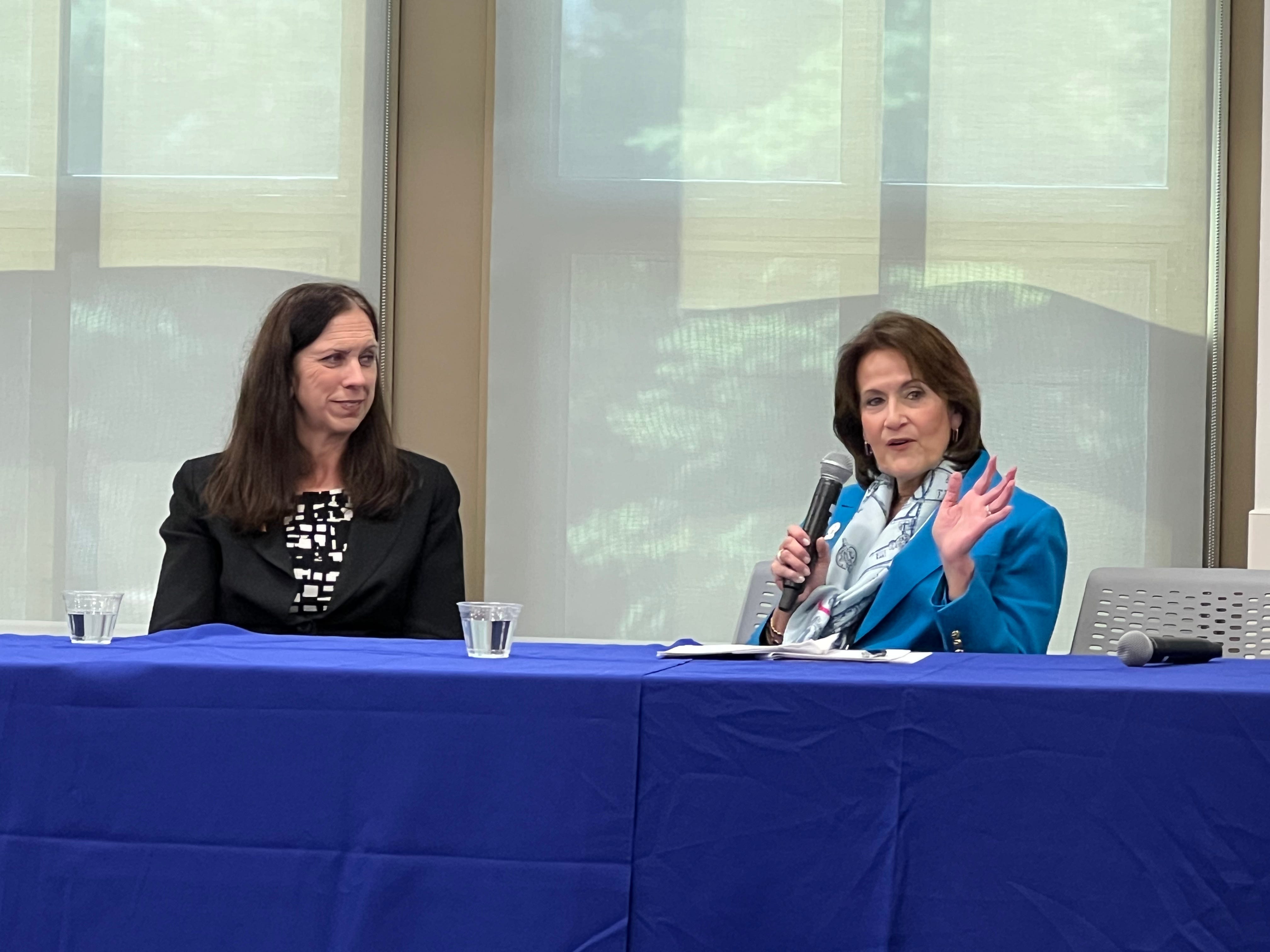
First Ladies and the People Who Tell Their Stories
Experts from diverse backgrounds gathered on Friday at a Washington, D.C., conference to talk about the evolving legacies of America’s first ladies.

On a bright and sunny Friday at American University in Washington D.C., students have wrapped up their school year. But inside the Mary Graydon Student Center, on an otherwise quiet campus, there were dozens of experts from diverse backgrounds who came together for their one common interest—American presidential first ladies.
They came to listen and share the stories of first ladies as part of this year’s 250th anniversary celebration of America’s founding at the conference, “250 Years of First Ladies Making History,” hosted by the First Ladies Association for Research and Education and American University School of Public Affairs First Ladies Initiative convening scholars, historians, authors, archivists, former White House staff, journalists, museum and historical site curators and digital creators.
The presentations spotlighted a range of aspects about first ladies. But, an underlying theme of the daylong event reminded attendees that, in many respects, history is just now catching up to the contributions presidential spouses have made. Or in some cases, biased narratives and dormant history of some first ladies is—as a result of reexamination by many female scholars and authors—being revived, reassessed and rewritten for the present day.
Indeed, this moment and this audience may be the long overdue moment Mary Todd Lincoln, one of the most maligned first ladies in history, has waited for.
As part of a panel discussing new and forthcoming books, panelist Lois Romano, author of An Inconvenient Widow: The Torment, Trial, and Triumph of Mary Todd Lincoln due out on Tuesday, declared she wanted to bring back the tragic first lady’s humanity. Mrs. Lincoln’s legacy was shaped early on by unbalanced narratives drafted by mostly men during Abraham Lincoln’s presidency that led the nation through the Civil War and preserved the Union. Her legacy was also collateral damage of her husband’s assassination shortly after the war ended as a result of unsympathetic views of how Mrs. Lincoln navigated her widowhood.

“Mary Todd Lincoln was the wife of one of the most consequential presidents in history,” Romano said. “But, I think history got her wrong. Or at least, they got her very, very incomplete.”
Gathered around round tables, attendees listened as Romano described the deep research and details she uncovered that went into the new Mary Lincoln biography and the impact that a modern lens has on the former first lady’s legacy. What made much of it possible, she noted, is the foundational work of Mary Lincoln biographer Jean Baker in her 1987 book, Mary Todd Lincoln: A Biography and the number of archives that have since been digitized. Specifically, Romano said, there was a batch of about 2,000 stories she accessed digitally covering a three-day trip Mrs. Lincoln took to New York in the aftermath of her husband’s death. It was a trip for which the widow was unfairly and harshly exploited.
Mary Lincoln’s legacy is defined by a lot of things, Romano explained. It was defined by the Civil War, by some of her missteps and by the lack of today’s medical advancements treating mental illness.
“Ultimately, it was defined by two men—one she loved and one she loathed,” Romano said.
One man, Abraham Lincoln’s law partner and an Abraham Lincoln biographer, William Herndon, couldn’t stand Mary. Romano briefly describes an incident between the two that involved Mary Lincoln not inviting Herndon to a dinner because he was drunk.
The other man was her son, Robert Lincoln, who had Mary Lincoln committed to an insane asylum after the assassination.
“Her son did a lot of damage to her,” Romano said, adding he did not have to have her committed and that there were other ways. Instead, her son basically labeled her as insane. “Those two men defined her post-presidency legacy and very few people were able to turn that around in the last 160 years.”

The panel, moderated by Michael LaRosa, former press secretary to First Lady Dr. Jill Biden, also featured Jill Abraham Hummer, author of Laura Bush: Texas Roots, Global Impact; Elizabeth “Jody” Natalle, co-editor of the forthcoming book First Lady Autobiography: Rhetorical Voices Beyond the White House; and Katherine Jellison, editor of Ohio’s First Ladies: From the Midwest to the White House.
Helping remind and reshape many first ladies’ legacies is the newly launched initiative In Pursuit. Colleen Shogan, former archivist of the United States and CEO of In Pursuit, headlined the conference and was interviewed by Anita McBride, executive-in-residence at the Center for Congressional and Presidential Studies at American University’s School of Public Affairs and director of the First Ladies Initiative. In Pursuit, an initiative of the Washington, D.C.-based organization More Perfect, includes an alliance of about 40 presidential centers and foundations and educational and civic initiatives from around the country. It aims to distill wisdom about leadership and democracy from former American presidents and first ladies and other experts through a series of essays that are being published throughout 2026.
In describing the project to the audience, Shogan recalled how McBride, co-author of Remember the First Ladies: The Legacies of America’s History-Making Women, reminded her that civics is not only about presidents, but also about the first ladies.
“That was music to my ears,” Shogan said.
The idea, Shogan noted, was that with the 250th anniversary of the country’s founding there hadn’t been a comprehensive account of the lessons learned from the past 250 years that would help propel the country into the next 250 years. The insight gained from first ladies helps fill in the gaps, especially where women are concerned.
Interestingly, when Shogan began building out the project, Hillary Clinton, Laura Bush and Michelle Obama signed on to contribute essays before their husbands.
“We had the former first ladies locked in initially. I knew when they came on board that we were going to get the former presidents, as well,” Shogan said. In fact, it was George W. Bush’s essay on George Washington that led the essay series on President’s Day. This week, the series continues with Franklin and Jane Pierce.
“There are things about Jane Pierce that I think are totally underappreciated in American history,” said Shogan, whose keynote was followed by a panel discussion moderated by Alan Lowe, host of the podcast series American POTUS and American FLOTUS, on selected first ladies—Caroline Harrison, Edith Wilson, Florence Harding and Pat Nixon.

The former first ladies were spotlighted by essayists Nancy Kegan Smith, past president of FLARE and retired director of Presidential Materials Division at the National Archives and Records Administration; Rebecca Roberts, author of Untold Power: the Fascinating Rise and Complex Legacy of First Lady Edith Wilson; and Heath Hardage Lee, author of The Mysterious Mrs. Nixon: The Life and Times of Washington’s Most Private First Lady. As a journalist for East Wing Magazine and a writer for the In Pursuit essay series, I also contributed to the panel discussion.
The conference was also a unique opportunity for attendees from a range of backgrounds to come together and learn more about what others are doing to further education about presidential spouses.

“We have never had a conference on first ladies that pulled together people with such varied backgrounds, very different methodologies, very different approaches to rhetorical scholarship to people who are writing things for middle school kids,” said Diana Carlin, president of FLARE. “We really get a lot of ideas from one another.”
McBride, who also served as chief of staff to First Lady Laura Bush, described the discussion throughout the day as a way to better understand how first ladies use their platform during their time period.
“We are always looking for ways with people who care about this topic to capture people’s attention, to pay more attention to first ladies,” McBride said.
This year, also marks the five-year anniversary of FLARE’s formation and the 15th anniversary of the First Ladies Initiative, which has hosted a variety of conferences on presidential spouses since 2011, including some that featured first ladies themselves in attendance.


The day kicked off with a panel moderated by Anne Mattina FLARE board member and professor emerita in the Department of Communication at Stonehill College in Easton, Massachusetts, that featured Michelle Gullion, senior director of curatorial services at the National First Ladies Library and Museum speaking on “Ida McKinley: An Unwavering Champion for Women’s Rights from the White House;” Nick Sacco, historian and curator at the Ulysses S. Grant National Historic Site in St. Louis, Missouri, speaking on “First Lady Julia Dent Grant: Business Partner and Political Advisor;” and Natascha Joselita Krocker of the Obama Institute for Transnational American Studies in Germany speaking on “The First Lady on the Cover: An Archive of Magazine Covers and the Cultural History of First Ladies.”


Other presentations included a panel moderated by Susan Swain, retired co-CEO of C-SPAN and a FLARE board member, that featured Tammy Vigil, a Boston University professor speaking on “First Ladies Making History Through Media;” Andrew Och, the “First Ladies Man” speaking on “Lucy Hayes: From the Battlefield to the White House;” Jayda Justus, “The History Mom,” speaking on “A Well-traveled First Lady: The Extraordinary Life of Louisa Catherine Adams;” and author Libby Carty McNamee speaking on “Dolley Madison: First Lady of the Land.”
Calendar
May 19, 2026
30th Rosalynn Carter Georgia Mental Health Forum
On May 19, 2026, the Carter Center’s Rosalynn Carter Mental Health and Caregiver Program will convene the 30th Annual Rosalynn Carter Georgia Mental Health Forum, a milestone gathering dedicated to advancing mental health policy, systems, and practice across the state of Georgia. Read more
May 21, 2026
Third Thursday: The Art of the First Lady
The National First Ladies Library & Museum presents an in-person program exploring the artistic traditions and the creative legacies of America’s first ladies through the art of needlework, craftsmanship and design with textile historian Denise Layman. This Third Thursday program starts at 6:30 p.m. local time and highlights the artistic talents and personal expression woven into historic textiles created by first ladies: offering a deeper understanding of how art reflected identity, history, and leadership. Read more
May 27, 2026
First Ladies on the Page Book Club
The National First Ladies Library & Museum presents a free, virtual staff-led discussion of Founding Mothers: The Women Who Raised Our Nation by Cokie Roberts at 7 p.m. EDT. The discussion will explore the women who helped shape the early United States. Read more
June 2, 2026
America at Night
David Lee, the CEO and president of the National First Ladies Library & Museum will be featured on the radio show America at Night at 10 p.m. EDT. Tune in here
June 3, 2026
Cookin’ with Congress: Drink Like a First Lady
The National First Ladies Library & Museum presents a one-of-a-kind, virtual mixology experience “Cookin’ with Congress: Drink Like a First Lady” with Bennett Rhea the viral creator behind “Cookin’ with Congress.” Step inside the private lives of America’s First Ladies—one cocktail at a time. Discover how drinks like Jackie Kennedy’s daiquiri and Dolley Madison’s Yard of Flannel offer insights into the personalities, eras, and cultural moments of the women who shaped history. Read more
Send calendar items, press releases and announcements to jtaylor@eastwingmagazine.com.