East Wing Ballroom Pitch Now Includes a West Wing Addition
The White House presented concepts for a 22,000-square-foot ballroom and first lady’s office suite. Then, floated balancing it with a West Wing colonnade addition.

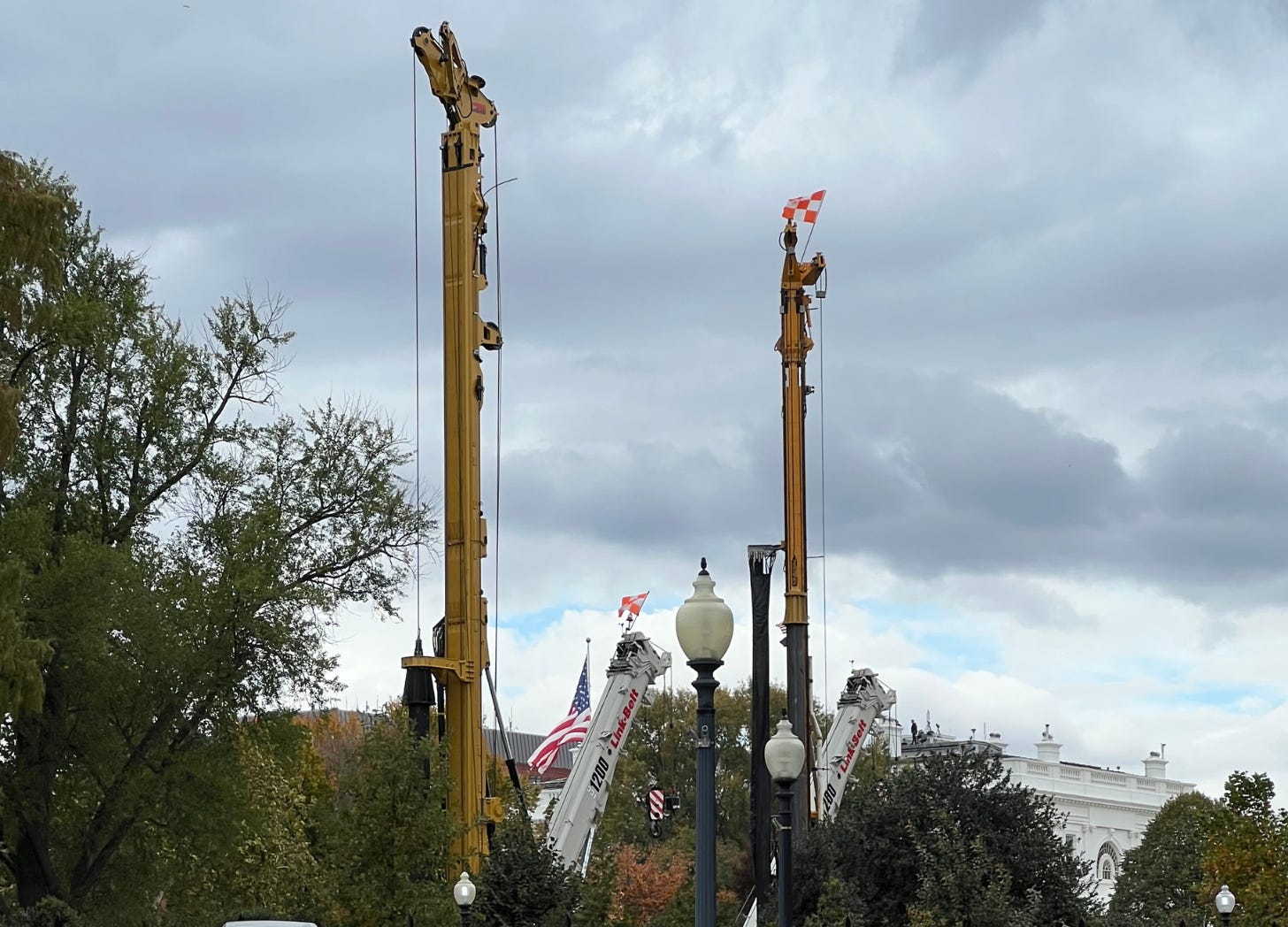
The first presentation of reconstruction plans of White House East Wing on Thursday showed a ballroom that could seat 1,000 people, an office suite for the first lady plus other newly proposed improvements on the campus including a one-story addition to the West Wing colonnade to address “symmetry” concerns from the aesthetics of the proposed oversized ballroom in relation to the historic residence.
An overview of the “East Wing Modernization Project” was held before the National Capital Planning Commission, a board that oversees federal construction projects in Washington, D.C., and included presentations by Josh Fisher, the director of management and administration for the White House, and Shalom Baranes of the Washington, D.C.-based architectural firm Shalom Baranes Associates (ABA), which was hired by the Trump administration in November after McCreary Architects withdrew from the project.

The White House East Wing was torn down beginning on October 20 to make way for President Donald Trump’s donor-funded $400 million and nearly 90,000-square-foot ballroom, sparking a wave of public outcry and a recent lawsuit from preservationists to try and halt the project.
The overview revealed some details—that the proposed ballroom cornice height would align and not exceed the cornice height of the White House, that the reconstructed East Wing would be set back slightly more than 10 feet from the White House’s north facade on Pennsylvania Avenue, and that the 22,000-square-foot ballroom’s ceiling height would reach about 40 feet.
“The heights will match exactly,” Baranes said of the proposed East Wing structure that will house the ballroom at the White House.
Situated on the second floor of the new addition that includes the East Wing colonnade, the ballroom would be designed for 1,000 seated guests at a formal dinner.
The functionality of the White House would also be improved with the new addition, Baranes said, who described the residence’s support areas—loading, waste handling and food service—as “quite labyrinthian in character.”
The working conditions, he added, place ongoing operational stress on the historic structure.
“The changes will allow the White House to be experienced and to age, I think, in a much more graceful way over time,” Baranes said.
The White House, in its presentation, asserted that hosting large-scale events in the White House “drastically increases the rate of deterioration” in the East Room and State Dining Room. Fisher also described the visitor experience upon entering the White House.
Visitors pass through temporary double-wide trailers to gain entry into state dinners or events with world leaders that would take place in a tent on the South Lawn, he said.
“These tents affected more than just the world leaders,” Fisher said. “Their use destroyed large portions of the South Lawn, degrading its appearance …and creating a reoccurring expense to replace and cultivate new grass.”
The White House also contended that it wasn’t cost effective to save the East Wing. Structural issues with the colonnade, past decay, water leaks, and mold, according to Fisher, made tearing down the structure more feasible.
Inside, details of the proposal were scant with officials promising more information at a future meeting. But, the lower level of the East Wing addition is where architects showed the future home of the Office of the First Lady suite. Directly opposite of the Office of the First Lady would be a large commercial kitchen devoted to food service that would serve the ballroom and all service events inside the White House. There were also plans to rebuild the movie theater on the lower level of the East Wing colonnade.
The overview drew concerns from two commissioners about the footprint and height of the proposed ballroom. Concerns were also raised about the presentation that “segmented” the project by introducing a proposed one-story addition to the West Wing colonnade that, according to Baranes, is being considered by the White House and vague statements about beautifying the visitor experience in Lafayette Park, which is located across Pennsylvania Avenue north of the White House.
The West Wing colonnade addition, Baranes said, would “reinstate the symmetry around the central pavilion of the White House.” Although, he noted, that they haven’t looked at that option at all yet, but hoped to do so in the future.
When ABA joined the project, Baranes said, they continued to evaluate various sizes and configurations for the ballroom project and that the “ultimate decision in late November was not to continue exploring options for increasing the size of the project. Instead, the decision was made to advance one of the earlier schemes that had been developed.”
Commissioner Phil Mendelson, who was concerned the ballroom addition was overwhelming the White House, asked whether the size of the footprint or location of the ballroom on the site could be changed at this point. To which Baranes replied that it largely depended on the schedule and money, but that his firm agreed with the previous architect that the current location was the best location for the ballroom because of its proximity to the East Room of the White House.
That prompted a follow-up question from Mendelson about whether construction work on the ballroom foundation had begun.
“There’s been excavation work. There [is] some foundation work, but that’s really not the limiting issue in terms of whether things can be changed or not,” Baranes said, who added that they are currently working with the footprint presented to the commission.
Commissioner Mendelson also asked the White House directly why the project didn’t come to the commission as a whole—like most projects—instead of after the demolition of the East Wing.
“There are some things regarding this project that are, frankly, of top secret nature,” Fisher said.
And that’s when NCPC Chairman William Scharf, a former personal lawyer of Donald Trump, interjected that the National Capital Planning Act does not give the commission the authority to review demolition sites or preparation work.
“While many projects do come before us at that stage, that’s not a requirement,” Scharf said.
A lawsuit was filed last month by the National Trust for Historic Preservation in the United States in an effort to halt the construction project. In a court filing last month John Stanwich, National Park Service Liaison to the White House, stated that many historic materials from the East Wing and East colonnade are planned to be reincorporated into the new wing. They include the East Wing cornerstone and plaque, historic fencing, historic windows, light fixtures, and the IM Pei-designed pergola from the East Garden, he said in the filing.
As the presentation concluded, Mendelson maintained that the proposed elevation as viewed from the Ellipse appeared “imbalanced” with the rest of the White House campus and that the current proposed square footage should not be the goal in and of itself. He was also disturbed by other proposals separate from the reconstruction of the East Wing and the ballroom addition.
“We’re looking at what appears to be an overall plan in a very segmented approach,” Mendelson said. “So there are going to be some changes to the visitor center. There are going to be some changes with Lafayette Park. There are going to be changes with the West Wing,” Mendelson said. “Rather than looking at this as a whole, we’re going to be looking at a piecemeal and that’s concerning, as well.”
The Commission of Fine Arts (CFA), the other board that oversees federal construction in Washington, D.C., is slated to review a concept design of the construction plans on Jan. 15. Final approvals could come as early as March and construction could start a month later. If the project moves ahead, it is anticipated to be completed in the summer of 2028, before Mr. Trump leaves office.


