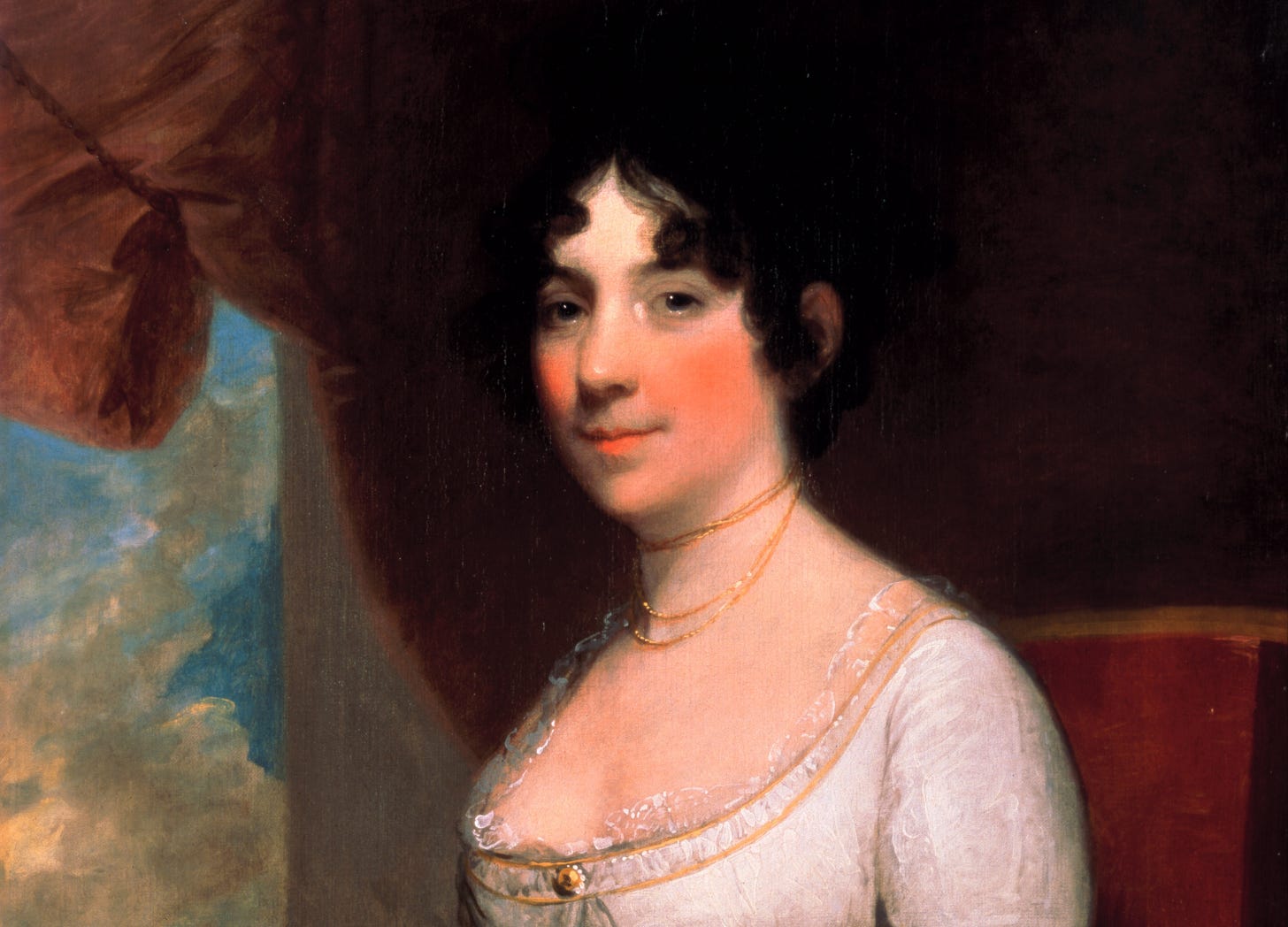
Dolley Madison’s Mingling Forged Connections Among Political Rivals
In Pursuit essay series continues this week with historian Catherine Allgor’s assessment of America’s socially savvy first lady.
Historian Catherine Allgor has written extensively on First Lady Dolley Madison (1809-1817). Her research shows the American founding-era, female figure achieved a level of fame that persists even to this day. That notoriety, stemming back to her carefully orchestrated, standing social gatherings, unfolded—not by accident—inside the executive mansion where she and her husband James Madison, the fourth president of the United States, resided.
Along the way, the descriptor “hostess” became intertwined with Dolley Madison’s contributions, a term Allgor tells East Wing Magazine in a recent phone interview that has a connotation of being frivolous.
But, Allgor describes how Dolley Madison’s weekly Wednesday receptions were far from frivolous in her essay “Democracy Works Best When Rivals Can Reconcile” exploring the lesson of how “democracy works best when political rivals see one another as human beings.” It is the latest installment of the In Pursuit essay series published on Thursday examining America’s presidents and select first ladies showcasing how Dolley Madison saw a government getting along—through human connection. The series is a bi-partisan initiative created by the Washington, D.C.-based organization More Perfect with the goal of distilling past presidents’ and first ladies’ wisdom about leadership and democracy.
“I’ve had people tell me, ‘Oh, she just loved parties,’” Allgor says of Mrs. Madison, noting, “but, there’s a purpose behind all of this.”
Rooted in that purpose is Allgor’s description of Dolley Madison’s “carefully constructed social world,” an undisputed underpinning in the form of weekly receptions that kept disagreeable founding-era politicians of the new United States focused on the common good. That world and attentiveness by the socially savvy then first lady, Allgor writes, was “an unofficial sphere where friends and enemies could resolve their differences.” It not only contributed to concrete political action, but it demonstrated a political lesson for the generations that have followed.
That lesson is what kept the young nation from fracturing, even if it was not explicit at the time.
Allgor writes that as early as 1800, it was clear that a government based on a theory that all governing men could agree on a single common good was not working. This is where the “unofficial sphere” came into play—at social gatherings, in parlors, drawing rooms or large parties. Dolley Madison and her architect, Benjamin Henry Latrobe, designed lavish rooms in the executive mansion intended for entertaining large groups, she notes in the essay.
The receptions “were so popular that attendees called them ‘squeezes,’” Allgor writes. “Every Wednesday evening, anyone in Washington City was invited to socialize in a freewheeling atmosphere.”
And they did—by the hundreds.
Those get-togethers took place in private spaces where male politicians as well as women and families, got to know one another. Using the distractions of food, wine and music under soft candlelight could bring legislators together to propose, negotiate and make deals, Allgor writes.
“I really concentrated on those weekly get togethers in Washington City to show how an unofficial sphere works,” Allgor says.
They worked so well, Allgor writes, that soon enough people counted on the receptions as “a place to be seen” and because of their regularity they became an institution and a venue to get things done unlike in the “official spheres.”
“Congressmen might rail at each other in the halls of government, dueling and fighting in the streets, but at Mrs. Madison’s squeezes they had to behave,” she writes.
Nowadays, it’s the “unofficial sphere” that seems to be missing in national politics. Lawmakers no longer have to move their families to Washington, D.C., for the congressional season, Allgor says. Instead, many opt to fly home for the weekends and the costs are the connections made across party lines.
“It’s kind of hard to see your political opponent across the aisle as the embodiment of evil when you just had a barbecue at his house and your kids go to school together and have sleepovers and your wives are working on a charity together,” she says.
While Allgor deconstructs the critical role Dolley Madison’s facilitated mingling played among leaders and lawmakers of the time, she hopes readers also start connecting the dots about the women serving in the first lady role. Scholars studying first ladies are shifting from a traditional biographical approach to one that is more analytical, she says.
“You’ll see in this essay we get right to the squeezes,” Allgor says. “We look at the meaning of her work.”
And that, she notes, is an evolution of First Ladies Studies. “It’s actually saying: What can we learn from this first lady about America or democracy or how politics work?”