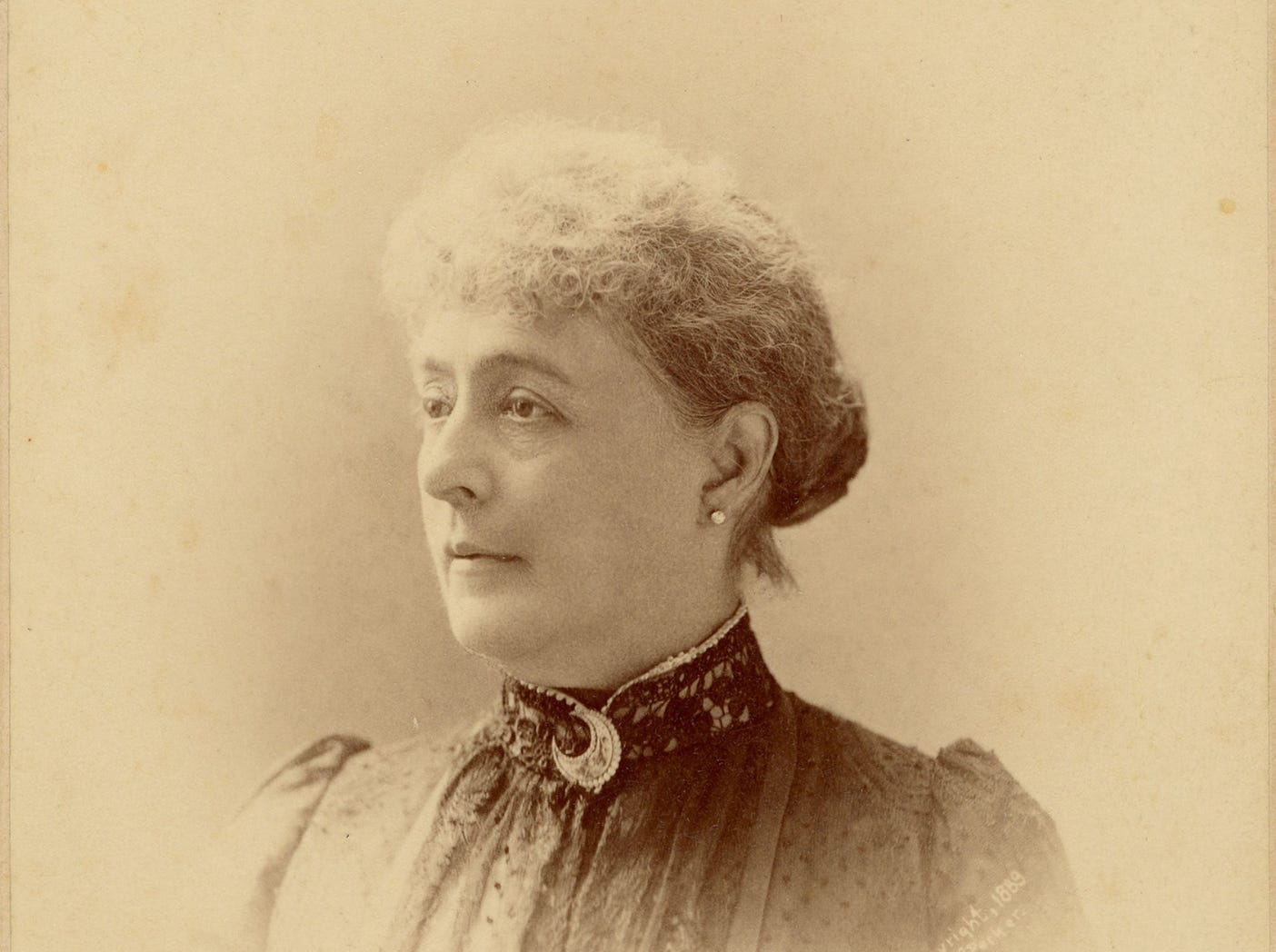
Caroline Harrison ‘Followed Her Own Path’
Nancy Kegan Smith spotlights a short-term first lady with a big impact in latest 'In Pursuit' essay installment.

Caroline Harrison is a lesser known American first lady. But she shouldn’t be, insists Nancy Kegan Smith, a first ladies expert and author of the In Pursuit essay published Thursday detailing the former first lady’s commitment to shaping an institution she knew others would inherit.
In fact, the White House of today exists in large part because of how Caroline Harrison helped shape the Executive Residence a few years before her death from tuberculosis there in October 1892. Switching on a light in the mansion, for instance, can be traced back to her extensive renovation of the White House that included installing electricity—even though, Smith says, those inside the White House were at first scared to turn it on.
Although Smith has written extensively about first ladies and is co-author of the recently updated book Remember the First Ladies: The Legacies of America’s History-Making Women, writing her essay Leaders Shape the Institutions Others Inherit was the first opportunity where she could study primary sources about Mrs. Harrison, the wife of Benjamin Harrison, the 23rd president of the United States. In Pursuit is a bi-partisan initiative created by the Washington, D.C.-based organization More Perfect aiming to share wisdom about leadership and democracy from former American presidents and selected first ladies.
The experience brought new information about the former first lady to light.
“It allowed me to do something I really love, which is original research and to find a lot of new things on her and shine a light, a deserving light on our semisesquicentennial on a first lady who hasn’t really been given her fair due in history,” Smith tells East Wing Magazine in a phone interview earlier this week.
Readers will learn from Smith’s essay that Mrs. Harrison recognized the need for updating the White House and envisioned something grand.
“She immediately became ‘concerned over the condition of the house,’ finding it in a state of terrible disrepair and noting in her diary ‘the rats have nearly taken the building so it has become necessary to get a man with Ferrets,’ to drive them out,” Smith writes. There’s more to that story in Smith’s essay.
While Mrs. Harrison dealt with the rats, she also lobbied hard for funds to renovate and enlarge the White House. Now more than 100 years later, Mrs. Harrison’s desire for an elaborate White House sounds coincidentally familiar as the Trump administration has undertaken several White House projects including the controversial White House ballroom proposed after the East Wing was demolished last October, a renovated Rose Garden patio and most recently a helicopter landing pad on the South Lawn.
Mrs. Harrison, however, submitted an architectural plan to Congress that preserved the Residence and proposed a $950,000 renovation that showed two large wings—the West Wing for office space and the East Wing for an art gallery, Smith writes. Her plan was rejected and instead she received $52,000 for restoration work.

“She really broke precedent in terms of first ladies publicly lobbying for things, and she lobbied for the White House,” Smith says, noting that when Grover and Frances Cleveland returned to the White House in his second non-consecutive term as president, they commented that they hardly recognized that it was the same White House.
Ultimately, Mrs. Harrison added more bathrooms, bedroom space and renovated the kitchen, floors and conservatory among other improvements. Her influence didn’t stop there.
Mrs. Harrison established the foundation for cataloging White House furnishings, something future First Lady Jacqueline Kennedy would build and expand on. Mrs. Harrison brought in other powerful Washington women for a White House china painting class and she, herself, was an artist and well known for orchid paintings. As first lady she was not a suffragist, but cared deeply about women’s advancement. She was a key component for fundraising in Washington D.C. for “The Women’s Medical School Fund Committee that approached Johns Hopkins University with a plan to raise $100,000 for their new school of medicine, provided that women were admitted on the same basis as men. The committee was successful,” Smith writes.
Mrs. Harrison was also named the first president of the National Society of the Daughters of the American Revolution.
“Women were so integral in the founding of this nation, but the Sons of the American Revolution said, ‘no,’” Smith notes, adding that the five women who founded the NSDAR came to First Lady Caroline Harrison to ask her to be the first president general.
In her research, Smith pointed out something notable about Mrs. Harrison upon her death at age 60: The New York Times wrote a lengthy and substantive obituary signaling how women and their achievements were given more recognition.
Smith hopes readers see what she saw in Caroline Harrison—a woman who had enough self-confidence that she didn’t let anyone box her in.
Updated July 24, 2026


